What Sausages Are Made Of: Revealing the Technological Secrets of Production
· Valerii Korolko · 7 min read
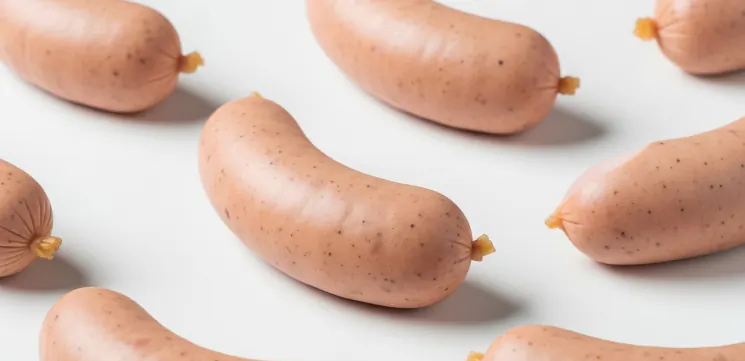
Main ingredients: what sausages are made of
The basis of any sausage, whatever its type, is meat raw material. It determines the texture, flavour and nutritional value of the product. So, what sausages are made of:
- Meat base:
The main hero is, of course, meat. Most often it is pork or beef, sometimes a mixture of both. Personally, I like working with young pork (most often from the loin or shoulder), because it gives that softness and juiciness. I choose beef to give a rich colour and a more "meaty" character. Some recipes also include chicken or turkey – this is a more economical option, but the texture becomes slightly "drier". Chicken is used to make dietary sausages and also to reduce the cost price. - Fat component:
Fat is not an enemy but an ally! The optimal level is 20–25% in the mince. It is responsible for that pleasant consistency when you squeeze a sausage and feel it spring back. - Water or ice:
It seems strange, but about 10–15% of water or crushed ice is added to the mince. This is not because we like to "dilute" – on the contrary, it helps activate the proteins and create a uniform emulsion. Thanks to this, sausage production results in a product that is so soft and uniform. - Spices and salt: salt brings out the flavour of the meat and gives a warm pink shade. Spice sets form an unforgettable flavour familiar from childhood.
- Binding agents:
Phosphates (for example, sodium tripolyphosphate): They increase the water-holding capacity of meat proteins, which makes sausages juicier and improves their texture.
Carrageenan, gums: They are used as thickeners and stabilisers to improve consistency and prevent moisture release.
This set essentially answers the question of how sausages are made: combine quality meat with fresh fat, enhance with salt and spices, add a little water and binding additives – and you get an excellent base for further processing.
Auxiliary components: what goes into sausages
You buy sausages and perhaps do not even notice that there is a whole "support group" of ingredients without which the product would not be safe or would simply not taste the way it does. So, the classic composition of sausages:
- Antioxidants: they prevent fats from oxidising, so that sausages do not develop an unpleasant aftertaste.
- Preservatives: sodium nitrite is responsible for colour, flavour and safety at the same time (as it inhibits the growth of bacteria, in particular Clostridium botulinum). In production we also use benzoate, sorbate, acetate or their mixtures (PRODAMIX BS20, PRODAMIX FRESH, Lactofresh) to make the product as safe as possible for the consumer.
- Colourants:
Natural and synthetic colourants are often used in the production of sausage products. The latter help give a brighter and more attractive colour, which arouses greater interest among customers. Prodservis offers a wide range of food colourants for meat and sausage products to cover all the possible needs of your production. - Flavourings and flavour enhancers
Thus, even a small spoonful of each of these ingredients significantly affects how consumers will assess sausage production: by colour, texture, smell and shelf life.
How do the ingredients of cooked, dry-cured and Munich sausages differ?
After two decades of work, I often joked that each type of sausage has its own "passport" specifying which components to use and in what proportions. Let us open these "passports" together.
Cooked sausages
Composition: the main emphasis here is on meat with fat (about 70% meat and 25% fat) and emulsion stabilisers. That is why they are so tender to the touch. We add salt, nitrite salt, a small amount of phosphates and the traditional set of spices. To our customers, for cooked-group recipes we recommend adding:
- Flavourings:Butter,Smoked Meat (a hint of smoke);
- Spices:Milk Lux Combi,Delicatessen Combi,Sausages Combi;
- Preservative:Prodamix BS 20;
- Stabilisers: Prodamix S-50, PRODAMIX F Tech;
- Colourants:PRODAMIX Color Uni.
Technology: after careful forming (that is, filling the casing) they are sent straight for cooking or pasteurisation: 75–80 °C for about 20–30 minutes. As a result, the sausages are completely safe and ready to eat.
Dry-cured (smoked) sausages
Composition: the quality of the meat matters here – the less fat (15–18%), the denser the structure. The main additions are starter cultures, salt, nitrite salt and spices. This is a more refined product that is not subjected to heat treatment (apart from smoking). Their composition is distinguished by a higher amount of high-grade meat, less water and the mandatory presence of starter cultures (enzymes), which ensure the fermentation and ripening process. Salt and spices are also used in higher concentrations. The drying process is lengthy and requires control of humidity and temperature. The fat content may also be higher to ensure better flavour and aroma during ripening.
Technology: after forming, the sausages are hung in a "drying" chamber. Temperature – 12–18 °C, humidity – 75–85%, duration – 2–4 weeks. After such drying they go for cold or hot smoking (20–30 °C or 55–65 °C respectively). The result is a rich flavour, a denser structure and a genuine smoky aroma.
Munich (Munich-style) sausages
Composition: 80–85% beef and 10–15% pork (the fat content is considerably lower – about 10%). The special process is ultra-fine grinding of the meat, almost to the state of a uniform creamy emulsion. Spices – a light emphasis on nutmeg and coriander.
These white sausages are a traditional Bavarian delicacy. Their composition is very specific: they are made mainly from pork and veal (or veal only), a large amount of fresh back fat, onion, parsley and lemon zest. A characteristic feature is the absence of nitrite salt, which is why they have a light, almost white colour. It is important that they are not intended for long-term storage and must be consumed on the day of preparation or the next day. They are boiled, not fried.
Technology: after forming, the sausages are lightly smoked (25–30 °C) for aroma, and then scalded with hot water or steam for 10–15 minutes. Thanks to this process the casing remains thin and the texture tender, almost "delicate".
As you can see, the difference in ingredients between cooked, dry-cured and Munich sausages includes not only the percentages of meat and fat, but also the subtleties of processing: fineness of grinding, smoking and drying regimes.
How to choose sausages with the best composition: advice from technologists
I often hear from acquaintances: "I want to buy decent sausages so that I don't regret it later." So, here are a few tips on how to find your way around the supermarket shelves and find out which sausage composition is genuinely healthy and tasty.
- Meat percentage and fat content: look at the labelling: if it states that the meat content is less than 60%, be vigilant. In quality cooked sausages this figure usually ranges between 65–75%. If you see "meat product", that is a hint that soy protein may replace part of the meat.
- The amount of stabilisers and colourants: phosphates (E450–E452) are nothing to fear if they are within the norm. I always say: better less, but of higher quality. The shorter the list of components, the more "natural" the sausages.
- Production and expiry dates: cooked sausages usually "live" for 5–7 days in the refrigerator. If you see a shelf life of 20–30 days, ask yourself: how many preservatives are definitely in there? Buy fresher batches and make sure the production date is as close as possible to the day of purchase.
- Certifications and reviews: ISO and HACCP certificates and compliance with DSTU or European standards are a good sign. If brands boast "GMO-free" or "No colourants", that is also an advantage.
- Do not hesitate to read reviews online and ask the opinion of acquaintances: people often share their own experience – and some producers turn out to be far better than "well-promoted" brands.
- Assess the appearance: sausages should have an even colour (depending on the type), without green or grey spots. The casing should be intact, without damage.
By choosing correctly, you will have in your refrigerator not just a "raw product" but the result of genuine technological mastery: it is how sausages are made that determines not only the taste, but also your confidence in their quality and safety.
Read also
- German technologist: what to produce tomorrow?
- Yoghurt production: from delicate texture to new product concepts with Prodservis
- European Insight: Tastes, Trends and New Products
- Marbled Beef Reimagined: Technology for Creating a Higher-Value Product
- Fertilisers for houseplants: how to choose and use them
