Yoghurt production: from delicate texture to new product concepts with Prodservis
· Maryna Petruk · 6 min read
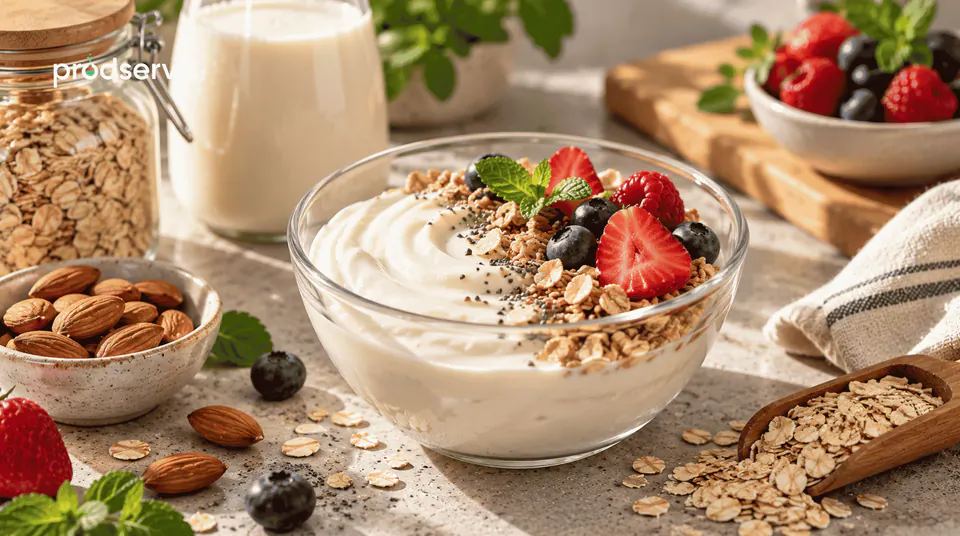
Thick Greek yoghurt, a delicate drinking product or a yoghurt with a pronounced fermented-milk note. Behind each of these formats lies the centuries-old history of a product that people learnt to make by fermenting milk.
It is fermentation that gives yoghurt its characteristic fermented-milk taste, delicate consistency and recognisable aroma. Over the centuries this product has travelled from a traditional food to an entire category, in which classic yoghurts, thick high-protein products, drinking formats and new functional concepts now coexist.
Each format has its own technological challenges, and the starter culture largely determines the result: from taste and consistency to the stability of the product during storage.
The Prodservis portfolio includes cultures from the French manufacturer BIOPROX for classic and functional yoghurts, bioprotection and the development of new fermented products.

From classic to Greek yoghurt: why one starter is not enough for every task
Yoghurt production begins with defining the characteristics of the future product.
For classic yoghurt, a balanced taste and stable consistency may be important. A drinking format requires different rheological properties. Products with a pronounced fermented-milk note need a corresponding flavour profile.
"Some cultures give texture, others provide a more pronounced aroma, and others have low post-acidification. There are also cultures developed for a distinctly fermented-milk taste," says Maryna Petruk, dairy technologist at Prodservis.
The choice of starter affects far more characteristics than the speed of fermentation. The producer needs to consider what the product should be like immediately after production and how its properties will change during storage.

Post-acidification: why the taste of yoghurt changes during storage
Yoghurt may meet all expectations immediately after production, yet gradually become more sour during storage.
The cause may be post-acidification, that is, a further increase in acidity in the finished product due to the activity of the starter microflora.
It is important for the producer to control not only the final fermentation parameters, but also how the taste of the product changes throughout its entire shelf life.
Maryna Petruk draws attention to BIOPROX's experience in the markets of China and India. Complex logistics and the risk of temperature-control violations have created additional requirements for the stability of fermented milk products.
This experience has contributed to the development of a range of cultures focused on preserving the taste and texture characteristics of the product.
The Prodservis portfolio includes BIOPROX cultures with different post-acidification characteristics. They make it possible to select solutions that take into account the desired taste, shelf life and the logistics of the enterprise.

Bioprotection: how to reduce the risk of spoilage in dairy products
The stability of yoghurt depends not only on the starter that forms its taste and consistency. Yeasts and moulds can cause spoilage of fermented milk products. For the producer, this means product losses, complaints and additional costs.
Protective cultures help to reduce these risks.
The Prodservis portfolio includes BIOPROX protective cultures, in particular RP80, P83, P94 and SP86. They contain specially selected microorganisms capable of inhibiting the growth of certain undesirable yeasts and moulds.
Their action depends on the specific strain and the food matrix. It may be linked to the formation of antimicrobial metabolites and competition with undesirable microflora.
Protective cultures can help to reduce the risk of spoilage, maintain product stability and cut food losses. They also open up opportunities for developing products under the Clean Label concept, with a shorter and clearer list of ingredients.
Greek yoghurt: thickness, creaminess and stability
Delicate, creamy, with a characteristic fermented-milk note. Greek yoghurt has long gone beyond an ordinary breakfast: it is combined with berries and granola, used instead of sour cream, and for making sauces, desserts and protein snacks.
According to Maryna Petruk, Greek yoghurt is currently one of the most popular requests among the company's customers. Producers are looking for ways to achieve a thick, uniform consistency and a balanced taste, and to maintain these characteristics throughout the shelf life.
Traditional technology involves removing part of the whey, which gives the product a denser structure and a higher protein concentration. However, thickness alone does not guarantee the desired result. The yoghurt must remain creamy, without graininess or excessive whey separation, and its taste must not become too sour during storage.
The Prodservis portfolio includes BIOPROX starter cultures with different texturising properties and post-acidification characteristics. This makes it possible to select solutions according to the composition of the milk base, the desired consistency and the flavour profile of the finished product.

Five new directions: how to expand a yoghurt-based range
Classic yoghurt can become the basis for entirely different products: from a refreshing frozen dessert to a functional drink with collagen.
For a dairy enterprise, this is an opportunity to consider new formats, flavours and consumer audiences, using its own expertise in fermentation.
Yoghurt with collagen: a functional drink in a new format. Combining a fermented milk base with collagen makes it possible to develop new functional products. For the producer, it is important to preserve a pleasant taste, uniform consistency and stability of the drink throughout its shelf life.

Frozen yoghurt: a dessert with a characteristic fermented-milk note, for which far from every yoghurt culture is suitable. Not all strains can withstand freezing and low-temperature hardening while surviving in the finished product. BIOPROX has a separate range of cultures selected specifically for the production of frozen yoghurts, which gives producers the opportunity to develop this format as a separate range direction.
Regional products: from ayran to lassi. Traditional fermented milk drinks from different countries can become a basis for expanding the range. Regional products differ in taste, consistency and production features, and require an appropriate choice of cultures.
Goat's milk yoghurt: a different raw material, a new flavour profile. Goat's milk differs in composition and behaviour during fermentation, which affects curd formation, whey separation and the consistency of the finished product. The Prodservis portfolio includes BIOPROX cultures for fermenting goat's milk, making it possible to select solutions that take into account the features of this raw material.
Plant-based alternatives: creamy texture without milk. Soy, oat and other plant bases open up opportunities for creating fermented products without dairy ingredients. At the same time, differences in the composition of the raw material require an individual approach to fermentation and texture formation. For this direction, BIOPROX offers specialised VEGI-PROX cultures.
From idea to production trial: Prodservis technological support
Greek yoghurt with a thick texture or a functional drink with collagen – each concept requires an appropriate technological solution.
Prodservis has BIOPROX starter, protective and probiotic cultures in its portfolio and helps dairy enterprises select them according to the characteristics of the future product.
Technological support includes analysing the producer's request, selecting ingredients, providing samples and organising production trials.
Are you planning a new yoghurt or want to improve the characteristics of a product you already make?
Contact the Prodservis technologists. We will discuss your task, select BIOPROX cultures and test the solution in production.
Prodservis LLC
tel.: (050) 425 50 04
info@prodservis.com.ua
