Which fertilisers to use in a greenhouse
· Valerii Korolko · 4 min read
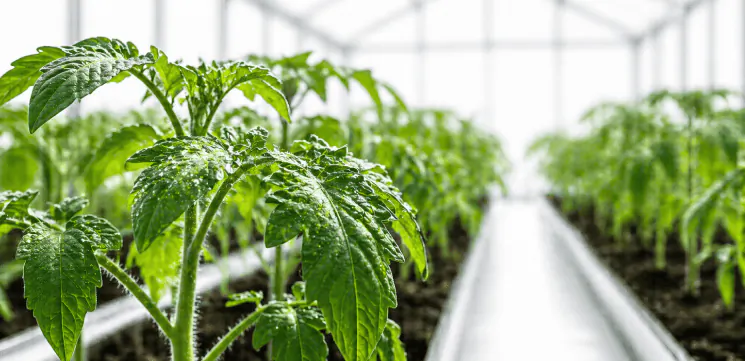
The principle of "fertilise the soil once and wait for the result" does not work here. In a greenhouse, it is important to understand what is happening with the plant at every stage. Proper feeding of greenhouse soil is the basis of stable growth, a good harvest and product quality.
Put simply, mineral fertilisers for greenhouses are most often used in water-soluble form and supplied through irrigation. This makes it possible to control nutrition as precisely as possible.
How feeding in a greenhouse differs from open ground
Environmental control and growth rate
Plants grow faster in a greenhouse, so any mistake in nutrition shows up within a few days. It is easier to control temperature, humidity and irrigation here, but for this reason you need to be much more precise. For example, an excess of salts or an incorrect balance of elements (nitrogen, potassium, calcium) affects the plant immediately.
The impact of irrigation and the limited soil volume
In a greenhouse, irrigation is the main way to deliver nutrients. This is precisely how the feeding of greenhouse soil takes place. But there is a nuance: the soil is not washed by rain. As a result, salts gradually accumulate, which can suppress the root system. That is why it is important not just to know what to fertilise greenhouse soil with, but also to control concentrations.
Why mistakes show up faster
In open ground, mistakes are partly compensated for by natural processes. A greenhouse has no such "safety margin". An overdose or incorrect mixing of fertilisers can produce a result in as little as 3–5 days: yellowing of leaves, scorching, slower growth, and so on.
Which fertilisers to use in a greenhouse
Greenhouses mainly use mineral fertilisers for greenhouses in water-soluble form: nitrogen (for example, calcium nitrate), phosphorus (monopotassium phosphate), potassium (potassium nitrate), magnesium and calcium fertilisers, and trace elements (iron, boron, zinc, etc.).
If the question is which mineral fertilisers should be applied to speed up fruit ripening, the key roles are played by: potassium, phosphorus, and a balance with calcium
They are what influence the formation and quality of the fruit.
How to choose fertilisers for the crop and growth stage
Initial period
At the start, the plant is very sensitive. The main thing here is not to overload it. The fertilisers you plan to use should be of moderate concentration, easily available and aimed at root development.
Vegetative growth
During this period, the plant actively builds up green mass. More nitrogen and potassium are needed. But it is important not to overdo it, otherwise the plant will "go to leaf" instead of producing fruit.
Flowering and fruiting
This is the most critical stage. It is important here to maintain a balance of nitrogen and potassium, provide the plants with enough calcium and keep nutrition stable. It is during this period that the question often arises: which mineral fertilisers should be applied to speed up fruit ripening – the answer: focus on potassium and phosphorus.
How to build a fertiliser application system
Through irrigation
The main method is fertigation (application through irrigation). It allows elements to be distributed evenly, nutrition to be adjusted quickly and fertilisers to be dosed precisely.
Foliar feeding
We use it as an additional tool for deficiencies or as quick help for the plant. But it does not replace the main nutrition.
Frequency and concentrations
There is no universal scheme. Everything depends on a number of factors: the crop itself, the growth stage, the water, the temperature, and so on. That is why it is important not just to fertilise the soil, but to build a coherent system.
Common mistakes when using fertilisers in a greenhouse
The most frequent mistakes:
- searching for a single "magic" fertiliser;
- no control of pH and EC;
- mixing incompatible products;
- overstating concentrations.
And one more critical mistake – ignoring water quality.
Practical recommendations for farms
How to start with a basic scheme? You need to start simple! Analyse the water and soil, and select fertilisers for the crop. A simple system is better than a complex and uncontrolled one.
What data needs to be monitored? Be sure to monitor the pH and EC levels, the condition of the leaves, root development and growth dynamics.
When should the system be adjusted? Adjustment is needed if you notice that the water has changed, fruit quality has deteriorated, growth has slowed down or signs of deficiencies have appeared.
The conclusion is simple: a greenhouse gives more control – but requires a more precise approach. The right fertilisers for greenhouses are not just a product, but a system that works only when it is monitored and adjusted in good time.
Read also
- German technologist: what to produce tomorrow?
- Yoghurt production: from delicate texture to new product concepts with Prodservis
- European Insight: Tastes, Trends and New Products
- Marbled Beef Reimagined: Technology for Creating a Higher-Value Product
- Fertilisers for houseplants: how to choose and use them
