Fertilisers for houseplants: how to choose and use them
· Valerii Korolko · 7 min read
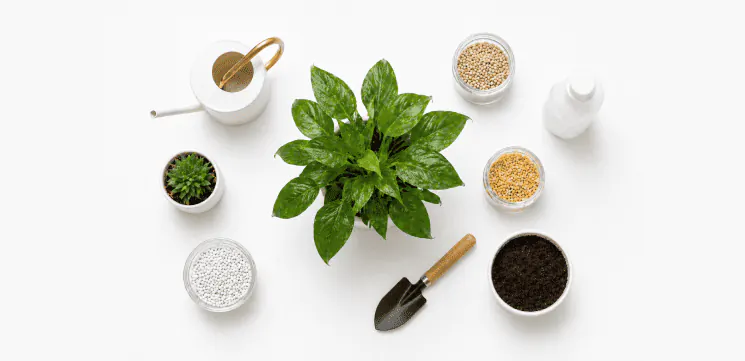
Most often the reason is simple: the plant lacks nutrients. Let us look at what to feed houseplants with, when to do it and how to avoid causing harm.
When houseplants need feeding
Periods of active growth and dormancy
Houseplants live by their own rhythm, and this rhythm is tied to the time of year – even if the pot stands on the windowsill all year round.
In spring and summer most plants grow actively: new leaves appear, buds form and shoots stretch upwards. This is when the need for nutrients is highest. Feeding begins in March–April, when daylight hours noticeably increase, and continues until August–September.
In autumn growth slows down. The plant gradually switches to economy mode. From October feeding is reduced or stopped altogether.
Feeding houseplants in winter
In winter most houseplants are dormant. Metabolism is slowed down and the roots barely absorb nutrients. If fertilisers are applied at this time, they will not be taken up but will remain in the soil and raise the salt concentration, which can scorch the roots. So the use of fertilisers for houseplants in winter must be especially careful.
There are exceptions: plants that flower in winter (cyclamen, poinsettia, winter azalea) need feeding precisely in this period – but in reduced doses.
When feeding can do harm
There are situations when a plant should not be fed even in the growing season:
A freshly repotted plant. Fresh soil already contains nutrients. Additional fertiliser after repotting is an unnecessary burden on damaged roots. Wait 4–6 weeks.
A sick or weakened plant. Fertiliser does not cure – it only increases the load on a weakened system. First eliminate the cause of the problem, then feed.
A plant in dry soil. A concentrated fertiliser solution in dry soil burns the roots. Always feed only after watering or at the same time as it.
How to tell that a plant lacks nutrients
A plant cannot say in words that it feels unwell – but it signals through outward changes. It is worth learning to read them.
- Lower leaves turn yellow, growth has slowed down, new leaves are small and pale – most likely a lack of nitrogen.
- Leaves are dark green, but the plant does not flower or flowers weakly – possibly too much nitrogen and too little phosphorus.
- Leaf edges turn brown, leaves curl – a lack of potassium.
- Young leaves are deformed, the growing point dies off – a deficiency of calcium or boron.
- Interveinal chlorosis (veins are green, with yellow between them) – a lack of iron or magnesium.
If you see several of these signs at once, the plant has most likely not received proper feeding for a long time or the soil is completely depleted.
Which substances matter in fertilisers
Before choosing fertilisers for houseplants, it is worth understanding what exactly in them the plant needs.
Nitrogen (N) is responsible for the growth of green mass, leaf colour and the plant's overall vigour. Nitrogen fertilisers for houseplants are especially relevant in spring – at the start of the growing season.
Phosphorus (P) stimulates the development of the root system and is responsible for flowering and fruiting.
Potassium (K) strengthens cells, increases resistance to diseases and stress, and improves the quality of flowering and fruit.
Calcium, magnesium, sulphur are secondary macronutrients. Calcium is important for the strength of cell walls, magnesium for the synthesis of chlorophyll.
Micronutrients (iron, manganese, zinc, boron, molybdenum, copper) are needed in minute amounts, but without them normal development is impossible.
Types of fertilisers for houseplants
Mineral fertilisers for houseplants
Liquid concentrates are diluted in water and used to water the plant. They are suitable for regular feeding throughout the season.
Water-soluble powders and granules are dissolved in water before use.
Soil sticks and tablets are a convenient option for those who do not want to bother with dilution. You insert a stick into the soil and it gradually releases nutrients over 1–3 months. The downside: it is hard to control the dose and the evenness of distribution.
Which nitrogen fertilisers are used for houseplants in mineral form: most often urea (carbamide) or ammonium nitrate as part of complex liquid fertilisers. In pure form they are almost never used for houseplants – the concentration is too high and it is easy to get the dose wrong.
Organic feeds are, as a rule, liquid vermicompost (humates), bone meal infusion or special organic concentrates.
Liquid vermicompost is probably the most convenient organic option for home use. It is safe, has no sharp smell, acts gently and does not scorch the roots even if the dose is slightly exceeded.
Specialised fertilisers
The market offers fertilisers for houseplants developed for specific groups:
- For orchids – with a reduced concentration and without urea.
- For cacti and succulents – with low nitrogen and increased potassium.
- For roses and flowering plants – with an emphasis on phosphorus and potassium.
- For citrus – with a balanced composition and chelates of iron and manganese.
- For seedlings – with increased phosphorus for root system development.
Among Ukrainian manufacturers of fertilisers for houseplants, always check the composition before buying, and the presence of micronutrients in chelated form – this is a sign of a quality product.
How to choose a fertiliser for a specific plant
For decorative foliage plants
Ficuses, monsteras, dracaenas, palms, dieffenbachias – all of them are grown for their foliage. They need, above all, nitrogen for a dense green crown and balanced potassium for leaf strength.
Using fertilisers for houseplants of the decorative foliage group: regular feeding with a liquid fertiliser with a higher nitrogen content – once every 10–14 days from March to August. In September–October the frequency is reduced to once a month. From November to February – a pause.
For flowering plants
Violets, spathiphyllums, anthuriums, begonias, chrysanthemums – phosphorus and potassium matter to them. These elements are responsible for bud formation and the duration of flowering.
Flowering plants need nitrogen in moderation: too much nitrogen and the plant will build up leaves instead of flowers.
Feeding scheme: in spring, when the plant starts to grow after winter dormancy – several feedings with increased nitrogen for recovery. Then switch to a fertiliser "for flowering plants" with an emphasis on P and K. During active flowering – once every 7–10 days.
For succulents and cacti
This is a separate category, where mistakes are often made. Succulents and cacti grow slowly and need minimal nutrition. An excess of fertiliser – especially nitrogen – makes the plant "swell", lose its shape and become vulnerable to rot.
Feed only in the active season (April–August), once every 3–4 weeks, at half the recommended dose. Use special cactus fertilisers or any mineral fertiliser with low nitrogen and increased potassium.
In winter succulents and cacti are not fed at all.
Practical care recommendations
How to combine watering and feeding
The main rule: fertiliser for planting houseplants is applied only to moist soil. This means that you either first water the plant with plain water and then with the fertiliser solution, or water straight away with the fertiliser solution in the usual amount. Never apply concentrated fertiliser to dry soil – it almost guarantees root burn, after which the plant takes a long time to recover. Do not combine feeding with heavy watering after which water runs out of the pot – the solution will simply drain away with the water before it can be absorbed.
If a plant has stood for a long time without feeding and you decide to resume – start with half a dose. A sharp transition from starvation to rich nutrition is also a stress.
How to adapt feeding to the season
Feeding is not a weekly ritual "because that is how it is done". It is a response to the real condition of the plant and the conditions in which it lives.
March–April: the plant wakes up. Start with one feeding a month – a small dose of nitrogen or balanced fertiliser.
May–August: peak activity. Feed once every 10–14 days. For foliage plants – an emphasis on nitrogen, for flowering plants – on phosphorus and potassium.
September: gradually reduce to once a month. Switch to fertilisers with less nitrogen and more potassium – this helps the plant prepare for dormancy.
October–February: for most plants – a complete pause. The exception is plants that flower actively at this time.
Fertilisers at planting deserve a separate mention. Fertiliser for planting houseplants is usually either a special soil with nutrients already added, or phosphorus-based rooting preparations that help the plant adapt faster to its new place. Additional mineral feeding in the first 4–6 weeks after repotting is not needed.
Caring for houseplants is about observation and common sense. Look at the plant, respond to its signals, and neither overfeed nor starve it. Properly chosen fertilisers for houseplants are not magic, but simply attention to what your green companion really needs.
