How to determine the fertiliser application rate
· Valerii Korolko · 9 min read
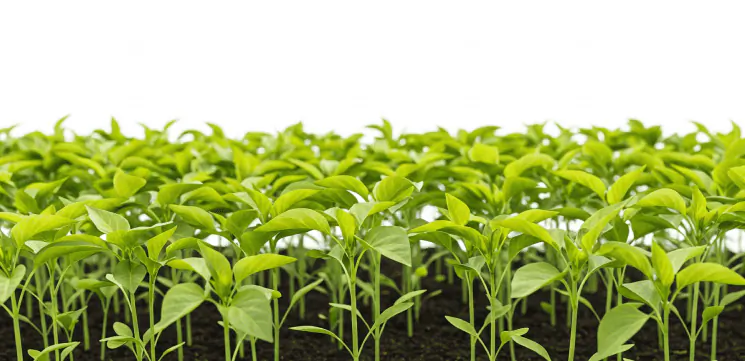
A correct calculation always rests on at least three things: the crop, the planned yield and the soil analysis data. For nitrogen, the preceding crop, the organic matter content and the risk of losses are also taken into account, while for phosphorus and potassium the main factors are the soil's nutrient availability level and the method of application.
Let us look at how to calculate the fertiliser application rate correctly: with formulas, tables and practical guidelines for different crops.
What the fertiliser application rate depends on
Fertiliser application rates are not fixed figures but the result of a calculation that takes several variables into account at once. The same field may require different approaches depending on whether the aim is simply to maintain the current yield, to bring a poor soil up to an optimal level, or to work towards a high planned result.
Planned yield. This is the starting point of any calculation. The higher the target yield, the more nutrients must be provided. Wheat at 5 t/ha and wheat at 8 t/ha are fundamentally different nutrition programmes.
Actual nutrient content of the soil. Without an agrochemical analysis, any calculation will be approximate. The soil already contains nitrogen, phosphorus and potassium in available or potentially available forms. Applying what is already sufficient means direct losses. That is why the mineral fertiliser application rate per 1 ha cannot be universal without reference to a soil analysis.
Nutrient use efficiency of fertilisers. Plants do not absorb everything that is applied. Some of the elements are lost, converted into unavailable forms or fixed in the soil.
Soil type and its agrochemical properties. On light sandy soils fertilisers are leached out faster, while on heavy clay soils they are retained for longer. Acidity (pH) directly affects the availability of phosphorus and trace elements.
Preceding crop in the rotation. After legumes, a noticeable reserve of biological nitrogen remains in the soil. After cereals, the soil is, as a rule, more depleted.
Method of application. With drip irrigation, fertiliser application rates are usually lower than with surface application, because nutrients are delivered directly to the root zone and absorbed more efficiently. With broadcast application, part of the fertiliser is inevitably lost.
How to calculate fertiliser requirements
Calculation based on yield
The first step is to determine the real, rather than the desired, yield. A competent system takes an average figure over several years, with adjustments for the field, hybrid or variety, moisture supply and technology. That is why the right approach starts not with a bag of fertiliser, but with the question: what yield is this field actually capable of producing in your conditions.
The basic calculation method is based on nutrient removal by the planned yield. The logic is simple: for each tonne of produce, the plant takes a certain amount of N, P₂O₅ and K₂O from the soil. The agronomist's task is to compensate for this removal.
Taking the soil analysis into account
An agrochemical analysis is not a formality but a tool for saving money. Without it, a farm applies fertilisers "blindly", risking either underfeeding the crop or overfeeding it and wasting money. The soil analysis shows the content of mobile forms of phosphorus and potassium, exchangeable acidity (pH), humus content and mineral nitrogen.
Conversion into active substance
Conversion into active substance is needed to understand how much nutrition the plant will actually receive, rather than how many kilograms of product have been applied per hectare. In agronomic practice, the calculation is made in terms of N, P₂O₅ and K₂O, and only then is this requirement converted into the mass of a specific fertiliser.
It is important not to confuse the composition of a fertiliser with its total mass. The basic formula is: fertiliser application rate = nutrient requirement / share of the nutrient in the fertiliser. The calculation is complete when the nutrient requirement has been converted into the exact amount of fertiliser per hectare.
| Situation | What to use as a basis |
|---|---|
| Field crops | Planned yield + soil analysis + preceding crop |
| Open-field vegetables | Nutrition plan by growth stage + soil analysis |
| Drip irrigation | Seasonal requirement + crop uptake schedule |
| Autumn application | Soil analysis + crop + soil type |
How to apply fertilisers correctly
Main application methods
Basic (pre-sowing) application. Carried out in autumn or early spring before ploughing or cultivation. Phosphorus and potassium fertilisers are applied at this time, since they have low mobility in the soil and need to be incorporated. Part of the nitrogen, a starter dose, may also be applied at this time.
At-sowing (row) application. A small amount of compound fertiliser is applied directly into the row during sowing. This provides starter nutrition for the seedling. It is important that the dose is not too high, otherwise an excess of salts in the row inhibits germination.
Top dressing during the growing season. Nitrogen fertilisers are mostly applied in split doses during the period of active crop growth. This reduces nitrogen losses from leaching and allows flexible management of nutrition.
With drip irrigation, mineral fertiliser application rates are calculated differently: the daily dose is divided by the number of irrigations and applied in portions throughout the growing season.
When it is best to apply
Autumn application. Phosphorus and potassium fertilisers are well suited to autumn, since they are not so easily leached out and have time to distribute evenly in the arable layer. For phosphorus and potassium, the full calculated dose is often given in autumn. Nitrogen is either not applied in autumn or applied at a minimum, because it is lost through leaching.
Spring application. The main dose of nitrogen is applied in spring, when the growing season resumes.
Fertiliser application rates and timing are always strictly tied to the crop's development stages. Nitrogen at the tillering stage works for the number of productive stems, while nitrogen at the stem elongation stage works for grain filling.
How to combine different types of fertilisers
Combining different types of fertilisers is primarily a matter of compatibility and agronomic feasibility. Nitrogen fertilisers are applied separately from calcium-containing ones. Phosphorus and potassium fertilisers combine well in basic application. With drip irrigation, calcium-containing fertilisers, for example calcium nitrate, and phosphate fertilisers are dissolved in separate tanks and fed in parallel to avoid precipitation.
Where errors occur in the calculation
Ignoring the soil analysis
This is one of the most common and costly mistakes. A farm applies a standard dose without knowing that the soil already contains enough phosphorus. As a result, money is spent and there is no effect or, even worse, salinisation occurs.
The optimal frequency of agrochemical analysis is once every 3–4 years on permanent fields. If the crop changes or the crop rotation system is disrupted, the analysis is done more often.
Incorrect rates
The second typical mistake is using outdated or averaged rates without taking specific conditions into account. Old reference books were calculated for other varieties, other agronomic practices and other yield expectations.
Modern intensive wheat varieties consume more nitrogen than older ones. Therefore, mineral fertiliser application rates taken without updating the data can lead to systematic underfeeding of the crop.
Errors in conversions
A classic mistake is confusion between the active substance and the physical mass of the product. The second typical problem is ignoring the form of the nutrient during conversion.
The accuracy of the machinery should also be considered separately: the permissible deviations from the mineral fertiliser application rate depend on the type of spreader, the machine settings and the evenness of distribution. If the machinery works inaccurately, even a correctly calculated mineral fertiliser application rate will not give the expected result.
How to avoid overspending and losses in efficiency
Optimising rates
Optimisation starts with a simple principle: no more than necessary. Excess application is not insurance but a direct loss. Excess nitrogen is leached into groundwater, phosphorus converts into less available forms, and potassium may increase the salt load.
Variable-rate application using agronavigation makes it possible to vary doses within a field according to the fertility map. Less is applied on better areas and more on poorer ones. This makes it possible to reduce overall costs without losing yield.
Monitoring the result
Agronomic monitoring throughout the season is a mandatory part of the system. Foliar diagnostics, visual or laboratory-based, make it possible to spot a deficiency or excess of nutrients in good time, before it affects the yield.
Leaf tissue analysis is a more accurate tool, as it shows the actual nutrient content in the plant, not only in the soil. For intensive crops this is especially relevant.
Adjustments during the season
A nutrition system is not a rigid plan but a flexible tool. If spring turns out cold and wet, nitrogen from the early top dressing may be partly leached out, and then an adjustment is needed. If the summer is dry, potassium uptake decreases, and the top dressing scheme is reviewed.
Practical recommendations for farms
How to build a calculation system
A calculation system is built in several steps:
- Determine the planned yield for each crop and each field.
- Carry out or update the agrochemical soil analysis.
- Calculate doses using the nutrient balance formula.
- Convert the doses into the physical mass of specific fertilisers.
- Distribute the doses by timing and application method.
- Record the actual application and the result.
This is not a one-off action but an annual cycle that becomes more accurate with each season.
What data needs to be collected
The minimum data set for a correct calculation:
- agrochemical soil analysis: pH, P₂O₅, K₂O, humus, mineral nitrogen;
- fertiliser application history for the last 3–5 years;
- yield data by field;
- information on the preceding crop;
- fertiliser specifications with the exact active substance content.
It is this data that makes it possible to move from averaged approaches to precise nutrition management.
How to choose a solution for your conditions
For small farms and farmers, the best route is often a simplified balance calculation based on the soil analysis and tabulated nutrient removal rates, adjusted for local conditions.
For medium and large agricultural enterprises, it is advisable to use nutrition calculation software, for example taking NDVI monitoring data into account, combined with laboratory control.
In both cases the starting point is the same: know what is in the soil, what the crop needs and how much it costs. Everything else is calculation technique.
Correctly calculating the fertiliser application rate is not an academic exercise. It is a practical tool that directly affects the profitability of every field. Start with a soil analysis, build the system and adjust it every season, and the result will not be long in coming.
Read also
- German technologist: what to produce tomorrow?
- Yoghurt production: from delicate texture to new product concepts with Prodservis
- European Insight: Tastes, Trends and New Products
- Marbled Beef Reimagined: Technology for Creating a Higher-Value Product
- Fertilisers for houseplants: how to choose and use them
