How to Stabilise Plant-Based Milk: 3 Producers' Secrets for the Highest Quality
· Maryna Petruk · 7 min read
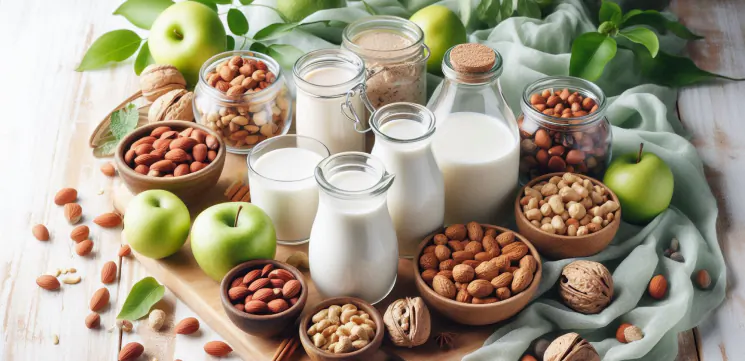
A popular choice for those who are lactose intolerant, allergic to dairy products, vegan, or simply prefer a plant-based diet.
Plant-Based Milk – Types
Let's look at which plant-based milk is healthier, which is lowest in calories, and its benefits for the human body:
- Almond: ground almonds and water, light, nutty flavour, low in calories.
- Soy: soaked and ground soybeans, creamy consistency, rich in protein, 80-100 calories per cup for the unsweetened version.
- Oat: oats and water, naturally sweet, smooth texture, 90-120 calories. Oat milk is higher in calories because of its natural carbohydrates.
- Coconut: ground flesh of mature coconuts, rich creamy consistency, distinct coconut aroma, 45-60 calories for the drinking version. Its calorie content is higher than that of almond milk.
- Rice: ground rice and water, thin and sweet, suitable for people with multiple allergies, 90-120 calories, more carbohydrates.
- Cashew milk: cashew nuts and water, creamy consistency, delicate nutty flavour, 25-50 calories for the unsweetened variety.
- Hemp: hemp seeds, omega-3 and omega-6 fatty acids, mild nutty flavour.
- Pea: processed yellow peas, high protein content, creamy consistency, 70-90 calories for the unsweetened variety.
Benefits of Plant-Based Milk
+ Lactose-free – an excellent option for people with lactose intolerance or sensitivity.
+ Lower calorie and fat content.
+ Vitamins and minerals:
– Calcium: important for bone health.
– Vitamin D: improves calcium absorption and supports immune function.
– Vitamin B12: necessary for the nervous system and the production of red blood cells.
– Vitamin A: vision and the immune system.
In addition, some plant-based dairy alternatives naturally contain beneficial nutrients: vitamin E in almond milk, omega-3 fatty acids in hemp milk.
+ Cholesterol-free.
+ A variety of flavours and textures.
+ Ethical and environmental benefits
– Animal welfare: avoids the consumption of animal-derived products, in line with the ethical beliefs of vegetarians and vegans.
– Lower environmental impact: producing plant-based milk requires fewer natural resources and results in lower greenhouse gas emissions compared with dairy farming.
+ Free from antibiotics and hormones
+ A variety of nutritional properties:
– Soy: high protein content similar to cow's milk, a source of essential amino acids.
– Oat: a source of fibre, including beta-glucan, which helps lower cholesterol levels.
– Hemp: omega-3 and omega-6 fatty acids.
+ Supports special diets: vegetarian, vegetarian, allergen-free diets, kosher and halal products.
Stabilising Plant-Based Milk
A critically important task for producers is ensuring the uniformity, consistency and high quality of the product. Achieving the ideal balance of texture and stability involves combining the necessary set of stabilisers, optimising homogenisation processes, controlling pH and temperature, and using high-quality raw materials. Let's delve into the key strategies and innovations that producers use to create premium products.
Choosing the right stabilisers guarantees a uniform texture and stability. They help prevent the separation of water and plant particles:
– Carrageenan maintains a uniform consistency and prevents separation.
– Guar gum is highly effective in small quantities, improves flavour, and helps suspend solids evenly in the liquid.
– Lecithin – an emulsifier for mixing fats and water, it ensures a smooth texture and supports consistency, especially in low-fat recipes, helps increase creaminess and improves stability.
Optimising the homogenisation process
Homogenisation is a key technological process in production. It involves breaking down fat and other particles into smaller, uniform sizes, which are then evenly distributed throughout the liquid; this not only improves texture but also increases the stability and shelf life of the product.
– High-pressure homogenisation – a method in which the liquid is forced through a narrow gap under high pressure. The intense pressure and turbulence reduce the size of fat globules and other particles, creating a stable emulsion; it is highly effective for creating a smooth and uniform texture.
– Ultrasonic homogenisation: uses ultrasonic waves to create high shear forces that break up particles; it is effective for reducing the size of large particles and improving the distribution of stabilisers and other components, and it preserves more of the nutrients and natural aromas of the ingredients.
Optimising homogenisation involves choosing the right method and parameters (pressure, temperature and duration) to ensure that the stabilisers are well integrated and the product remains stable and uniform throughout its shelf life.
Controlling pH and temperature:
– The pH level can affect the solubility and effectiveness of carrageenan and guar gum. Most plant-based dairy alternatives are slightly acidic, with a pH of around 6-7. Keeping the pH within this range ensures that the stabilisers work effectively and prevents coagulation or separation of the components.
– Temperature control plays a decisive role in the solubility and interaction of the components; it is important to keep it at a constant level for proper dissolution and dispersion of the stabilisers. Sharp fluctuations cause destabilisation and affect the final texture and stability. Heat treatment (pasteurisation) must be carefully controlled to avoid denaturation of proteins and other components.
The Importance of High-Quality Raw Materials
The quality of the raw materials significantly affects the flavour, texture and stability of the finished product. Using high-quality nuts, seeds, cereals or legumes is crucial for producing premium-class products.
– Source and quality: almonds, soy or oats should come from verified suppliers to guarantee the absence of impurities and the desired nutritional profile. High-quality raw materials give a better flavour, more stable fat and protein content, and fewer impurities.
– Processing methods: ensuring minimal exposure to heat and oxygen during processing preserves the nutritional properties and freshness of the components.
Innovations and New Approaches to Stabilisation
Advances in food science have led to innovative methods of stabilising plant-based milk, aimed at improving quality and meeting consumer demands for clean labels and nutritional properties.
– Nanotechnology – the process of manipulating ingredients at the nanoscale to improve their stability and functionality. Nanoparticles improve the solubility and distribution of stabilisers, creating more stable and uniform emulsions. It is used to encapsulate and protect sensitive nutrients, increasing their stability and bioavailability in plant-based milk.
– Biopolymers – natural polymers obtained from renewable sources: polysaccharides and proteins; an environmentally friendly alternative to traditional stabilisers that improve texture and flavour.
– Fermentation can produce beneficial metabolites to improve the stability, flavour or nutritional value of the product, in line with consumer preferences for natural and minimally processed products.
Thus, stabilising plant-based milk to achieve the highest quality requires a multifaceted approach. By carefully selecting stabilisers, optimising homogenisation processes, controlling pH and temperature, using high-quality raw materials and applying innovative technologies, producers can create premium plant-based milk that meets consumer expectations for flavour, texture and stability. Prodservis advises its customers to use only quality ingredients from well-known European manufacturers, in particular Ingrema AG – this will allow you to control the production process and create standardised products of the highest standard!
FAQ
What does stabilising plant-based milk involve?
Stabilising plant-based milk involves processes aimed at preserving its consistency and texture and restoring its structure after production processes such as pasteurisation.
What factors affect the effectiveness of stabilising plant-based milk?
The effectiveness of stabilisation depends on the correct choice of ingredients, their concentration, the temperature regime of processing and the duration of the product's storage.
What ingredients are used to stabilise plant-based milk?
The main ingredients for stabilising plant-based milk include humins, carboxymethylcellulose, gums, guar gum, pectin, agar-agar and some others.
Read also
- German technologist: what to produce tomorrow?
- Yoghurt production: from delicate texture to new product concepts with Prodservis
- European Insight: Tastes, Trends and New Products
- Marbled Beef Reimagined: Technology for Creating a Higher-Value Product
- Fertilisers for houseplants: how to choose and use them
