Heat-stable cheese for production: from cheese sausages to grilling products
· Valerii Korolko · 7 min read
Cheese has long since stopped being just a product. It works as a filling in sausages and grilling sausages, burgers, snacks, hot appetisers and HoReCa products. The consumer sees cheese in the name and expects a very specific experience: a distinct flavour, visible cheese inclusions, a pleasant texture and an appetising result after heating.
But it is temperature that often becomes the main test for such a product.
Cheese can melt excessively, leak out, lose its shape or turn into a paste-like mass inside the product. As a result, the component that was meant to increase the product's consumer value practically stops being noticeable.
But what if this behaviour can be controlled?
Then cheese can be viewed much more broadly. Not only as an inclusion in a meat product, but as the basis for a separate category: cheese steaks for the grill, medallions, snacks, cheese kabanosy, portioned products for HoReCa.
This is exactly how heat-stable cheese technology works.
For a meat processing company it is interesting for one more reason. Some of these products can be made using the technological base and equipment that the company already uses.
Cutter, vacuum filler, casing, heat treatment, cooling. Processes familiar to the technologist – a new product at the output.

What heat-stable cheese is
In the context of food production, heat stability means the ability of a cheese product to retain set characteristics under exposure to temperature.
The aim is not for the cheese to have no reaction to heating at all. What matters is to achieve controlled behaviour suited to the specific product and the way it is cooked.
For a sausage or a small grilling sausage, these can be visible cheese inclusions that do not disappear inside the meat matrix.
For a cheese medallion or steak, other characteristics matter: the product must retain its shape and texture during subsequent frying or grilling.
The technological logic looks quite simple:
cheese base → functional system → structure formation → heat treatment → stable product for further use
But the result is determined not by a single ingredient. What matters are the recipe, the temperature of the raw materials, the degree of comminution, the order in which components are added, the cutting modes, the forming and the subsequent heat treatment.
Cheese in meat products
For a meat processing company, the most obvious application of heat-stable cheese lies within an already familiar category:
- sausages with cheese
- grilling sausages
- burgers
- meat snacks
- fillings
- chopped semi-finished products
The "meat + cheese" combination is already understood by the consumer. The producer's technological task is different: to make sure the cheese genuinely creates value in the finished product:
- a visible inclusion gives a visual effect on the cut
- controlled behaviour during heating influences the consumer experience
- flavour variability makes it possible to develop one product platform into several SKUs
Cheese kabanosy: a familiar format with an entirely different product

The kabanos has a very strong visual code.
Thin. Portioned. Convenient to hold in the hand. It is immediately associated with a snack.
Now let us keep the format and change the product: inside is not meat. Inside is cheese.
This is how the Prodservis cheese kabanosy concept appeared: a cheese snack in the format of a kabanos or thin sausage with modern flavours:
- spicy
- smoked
- truffle
- chilli
- green herbs
This format has an important advantage from a marketing point of view. There is no need to explain to the consumer how to eat it. The shape already suggests the scenario.
Open the pack. Take it with you. Snack on the go, in the office, after a workout, or add it to a snack box.
Cheese steaks and medallions: entering the BBQ category

Cheese does not have to remain a component of a sausage or be just a snack. It can become the basis of a standalone product for the grill.
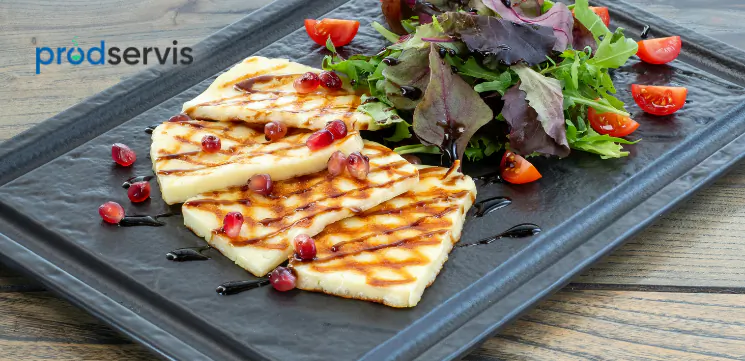
Imagine a thick golden medallion on a hot grate. The surface quickly turns golden-brown, an appetising crust appears, and the aroma of cheese mingles with grilled notes. Inside, a soft, juicy cheese texture remains. The steak holds its shape, can be turned with tongs, placed in a burger or served hot with vegetables and sauce.
This is what a heat-stable cheese steak can be.
For the producer, the appeal of the format lies in its variability. The basic concept can be developed into a whole range:
- classic creamy flavour
- jalapeño
- tomato and basil
- paprika
- aromatic herbs
- smoked and BBQ profiles
The shape, thickness, portion, flavour and packaging all change. From a single solution you can create products for retail, HoReCa, a seasonal BBQ range or Private Label.
A cheese steak also makes it possible to look at existing production in a new way. Some of the processes and equipment that a meat processing company works with every day can potentially be used to launch such a product. Whether a particular line is suitable is determined after assessment by technologists.
And the best way to understand the potential of a cheese steak for your range is to see it on the grill and try it.
What the producer gets
- Heat stability up to 250 °C. A cheese steak or medallion can be fried to a golden-brown crust and distinct grill marks, retaining its shape and juicy cheese texture inside. In sausages and frankfurters, the cheese remains a visible, appetising inclusion after heat treatment. For the producer, 250 °C means the freedom to create products in which the cheese withstands high temperatures and looks just as appealing on the plate.
- Low weight loss. During heat treatment the weight loss is only 15–20%. This figure is significantly lower than for meat analogues. More finished product from the same amount of raw material means a better yield and more attractive production economics.
- Shelf life of up to 8 weeks. The finished product retains its characteristics for up to 8 weeks, which gives the producer more time for sales and a much wider sales geography.
- An innovative product for the Ukrainian market. Cheese kabanosy and steaks make it possible to reach the shelf with an unusual format. This is a chance to take a new niche and build your own category ahead of competitors.
- No additional equipment. The new cheese line can be integrated into existing production, using the company's equipment and expertise.
- Gouda, cheese product, smoking, spices. Natural Gouda gives a rich, recognisable cheese flavour. The cheese product allows you to work with different SKU economics. Smoking adds an aroma that sounds particularly natural in kabanosy and grilling products. The range can then be developed through chilli, herbs, paprika, BBQ and other flavour profiles.
As a result, the producer gets a technological platform for an entire category of products: golden-brown cheese steaks and medallions for the grill, thin cheese kabanosy for snacking, cheese inclusions for meat products, different flavours and formats for retail and HoReCa. One direction gives several opportunities at once for launching and scaling the range.
And the consumer simply enjoys the taste
Global snacking is changing. A small pack that is convenient to toss in a bag is no longer enough for the consumer. People expect more from a snack: protein, convenience and a new consumption experience.
In 2026, Circana (a global American market research, data analytics and consulting company) recorded simultaneous growth in several snack categories at once – yoghurts, protein bars, meat and cheese snacks, popcorn and fresh products. This confirms that the growth of snacking does not rest on a single category, but is moving in several directions at once, where functionality and convenience matter more than familiar packaging.
Cheese itself is changing too. Instead of the traditional piece on a cheese board, bars, puffs, sticks, cubes and other on-the-go formats are appearing. People take them to work, put them in a lunchbox, eat them on the move, between meetings, before or after a workout.
Retail is already rearranging shelves for this behaviour. Grab-and-go zones with cheese products are expanding beyond convenience stores and appearing in traditional supermarkets.
The cheese kabanos fits this scenario very naturally: familiar cheese gets the format of a modern snack. Portioned, convenient, rich in flavour and unusual enough to make you want to pick it off the shelf and try it.
And the cheese steak answers a different demand: to get a new gastronomic experience without complicated cooking. Grill, golden-brown crust, cheese texture, a few minutes to a ready meal.
For the buyer, the choice becomes wider: cheese can be not only sliced for a sandwich. It can be taken along as a snack, put on the grill, added to a burger or turned into a quick hot dish.
Shall we try it at your plant?
Cheese steaks, medallions and kabanosy can already be moved from idea to production trials.
Contact the Prodservis technologists. We will work out the technology on your raw materials and equipment, assess the finished product and calculate its economic potential.
Read also
- Plant-based meat: how to achieve juiciness and a fibrous texture
- Plant-based meat alternatives: how vegan burgers, schnitzels and sausages are made
- The Future of the Meat Business: An Expert View from Ivan Sierov, Development Director at Prodservis
- Fillings for frozen semi-finished products: juiciness, texture and stability
- Dough for frozen semi-finished products: causes of cracking and technological solutions
