Breading plant-based products: how to achieve a crispy crust and keep the juiciness
· Olena Lobach · 10 min read
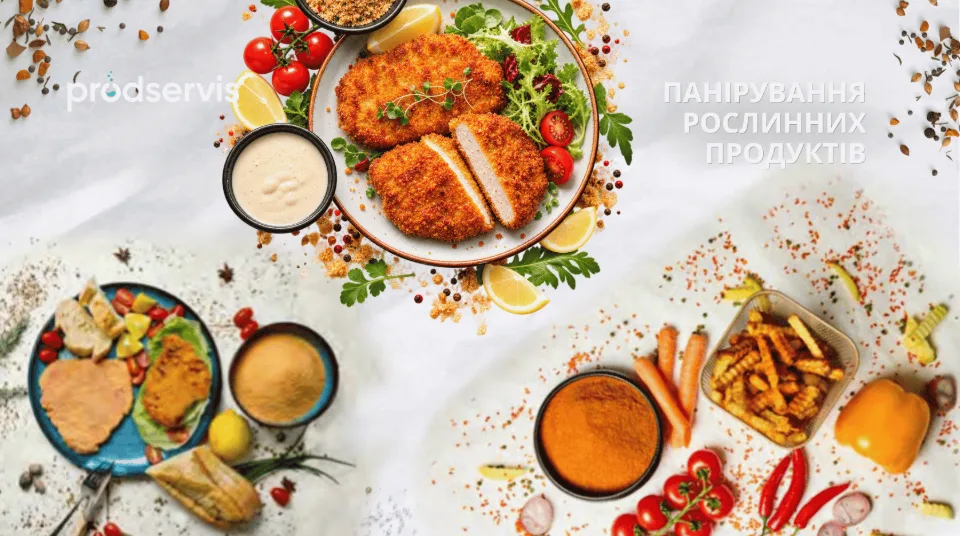
A golden crust, a distinct crunch at the first bite and a tender, juicy centre. This is what an appetising plant-based schnitzel, croquette or nugget looks like, one you want to taste even before it reaches the plate.
For the manufacturer, this combination is a complex technological task. The breading must cover the surface of the product evenly, hold well during frying, form the required texture and retain its properties after cooling or reheating.
Plant-based meat alternatives need particular attention. Their structure, water-binding capacity and behaviour during heat treatment differ depending on the protein base and the composition of the recipe.
Let us look at how a breading system works, what the crispness of the crust depends on and which ingredients help to create high-quality plant-based semi-finished products.
Why breading plant-based products requires a special approach
A plant-based schnitzel made from textured soy protein, a nugget based on pea protein and a croquette with textured rice protein may look similar but interact differently with the breading coating.
The reason lies in the properties of the product's internal structure.
Textured plant proteins differ in porosity, degree of hydration, and ability to retain moisture and form a cohesive mass. These characteristics affect the condition of the semi-finished product's surface and how well the coating adheres to it.
An excessively moist surface can impair the adhesion of the breading. Insufficient cohesion of the plant-based mass creates a risk of the product deforming, cracking and the crust peeling off.
Heat treatment also plays an important role. During frying, moisture moves from the inner layers to the surface, part of it evaporates, and the outer coating gradually acquires its characteristic structure.
Studies of breaded plant-based analogues of meat confirm that the batter composition and the cooking method affect weight loss, moisture content, fat absorption, colour and texture of the finished product.
Therefore, breading should be regarded as part of the technology for forming the finished product, and not merely as a decorative outer layer.
How a crispy crust is formed
During frying, several interrelated processes take place: evaporation of moisture, starch gelatinisation, changes in protein components, the formation of porosity and browning reactions, which give the characteristic golden colour.
The properties of the crust depend on the ratio of starches, flour components and proteins, the particle size of the breading and the specifics of the heat treatment.
Fine particles can create a denser, more even coating. Larger flakes or crumbs form a more pronounced relief and can give the product a more noticeable crunch.
However, the thickness of the crust does not always mean better crispness. An excessively dense or thick coating can become hard, heat unevenly or separate from the base.
For plant-based nuggets, schnitzels and croquettes, it is important to find a balance between a distinct crust and a pleasant sensation when biting, so that the breading complements the texture of the filling rather than dominating it.
Batter and breading: why they work together
In the production of breaded semi-finished products, a system of several functional layers is often used.
The batter creates an intermediate coating between the surface of the product and the outer breading. Its task is to provide sufficient adhesion, distribute the coating evenly and ensure its stability during further processing.
The breading mix is responsible primarily for the outer texture, colour, surface relief and the character of the crunch. The effectiveness of such a system depends on the compatibility of its components.
If the batter does not hold well on the surface, even a high-quality breading mix can fall off. If the coating is excessively dense, the finished product may lose the characteristic lightness of the crust.
The properties of the batter also affect the amount of coating that remains on the product. In technological practice, this indicator is called batter pickup. It is important for controlling the coating thickness, ingredient consumption and the stability of the weight of the semi-finished product.
Thus, batter and breading must be evaluated together with the plant-based base, and not as two independent ingredients.
How to keep juiciness under a crispy crust
The contrast between the crispy shell and the juicy centre is one of the most important sensory characteristics of breaded products. During frying, the outer surface loses moisture, while the inner part must retain enough water to form a pleasant texture.
The coating can influence the transfer of moisture and fat, but on its own it cannot compensate for the shortcomings of the plant-based base.
If the protein mass does not retain water sufficiently, the filling may remain dry after cooking even under a well-formed crust. On the other hand, an excessive amount of free moisture inside the product can cause the coating to become damp, lose its crispness or peel off.
The technological task is to balance two characteristics: retaining moisture inside the product and forming a crispy outer structure.
The result is influenced by the protein base, the functional components of the recipe, the properties of the batter, the breading mix and the cooking method.
Why breading loses its crispness after cooling
A freshly fried plant-based schnitzel has a golden crust that is dry on the surface. But after a certain time it may become softer, even if the product retains an appetising appearance.
One of the reasons is the redistribution of moisture.
After heat treatment is complete, moisture continues to move between the inner part of the product and the outer coating. When the crust absorbs moisture, its mechanical properties change: it becomes less brittle and loses its characteristic crunch.
This is associated, in particular, with the glass transition phenomenon and the transition of the coating structure to a more plastic state.
This is especially relevant for manufacturers of chilled and frozen semi-finished products. The product must retain the required properties not only immediately after production, but also after transportation, storage and final preparation by the consumer.
Therefore, evaluating breading only after the first frying is not enough.
Breading frozen plant-based semi-finished products
Plant-based nuggets, schnitzels, croquettes and other breaded products are often sold frozen. This format places additional demands on the coating.
During freezing and subsequent cooking, the distribution of moisture, the condition of the product's surface and the mechanical strength of the breading layer may change.
It is important for the manufacturer that the coating does not fall off during packaging, does not form significant cracks and retains its characteristic texture after cooking.
Different cooking methods should also be taken into account. A product intended for deep frying may behave differently when cooked in an oven or an air fryer.
Thus, it is advisable to select the breading system taking into account the entire life cycle of the product: from the formation of the semi-finished product to its preparation by the end consumer.
Plant-based schnitzels, nuggets and croquettes: different products, different crust requirements
Despite the shared principle of breading, each format has its own technological features.
- Plant-based schnitzels: A thin plant-based schnitzel with a fibrous structure needs a coating that spreads evenly over the surface and retains adhesion during frying. Important characteristics are a golden colour, a distinct crunch, no peeling and retention of juiciness in the inner part.
- Plant-based nuggets: For nuggets, shape stability, evenness of the coating and a characteristic crunch when bitten are of particular importance. Owing to the small size of the product, the ratio of surface area to weight is relatively high. This increases the importance of the coating's properties for the overall sensory perception of the product.
- Plant-based croquettes :Croquettes may have a more tender or more finely ground internal structure, in particular based on rice or other plant protein components. For them, it is important to form a coating that helps to preserve the integrity of the product and creates a contrast between the crispy shell and the soft centre.
A separate area is plant-based fish alternatives, where the breading must complement the delicate texture of the filling without creating an excessively hard crust.
Functional blends in the Prodservis portfolio
For manufacturers of plant-based semi-finished products, Prodservis offers ingredients that help to create breading systems with a distinct crispy texture and a stable coating.
- PANIER QUICK NP 50 Prodamix batter: a ready-to-use liquid base for breading that replaces the egg component. It ensures adhesion of the breading mix to the surface of the plant-based product, promotes even application of the coating and its retention during further processing. The composition includes water, modified starch, salt, thickener, acidity regulator and natural flavouring.
- PANIER-QUICK KNUSPERGOLD Prodamix breading mix: a spiced mix with large golden particles that forms a textured, crispy crust. The composition includes maize components, breadcrumbs based on wheat flour, spices and rapeseed oil. The coating gives products a characteristic spicy flavour and an appetising golden colour.
The combination of batter and breading mix makes it possible to create a complex coating for plant-based schnitzels, nuggets and croquettes, including products intended for freezing.
When selecting a system, oil absorption, retention of crispness after cooling and repeated cooking, and the stability of the coating after freezing are taken into account. These characteristics are tested for a specific recipe and heat treatment method.
Prodservis technologists help to assess the compatibility of ingredients with the plant-based base and to select a breading system in line with production requirements.
How to assess breading quality: indicators for the manufacturer
An appetising appearance of the finished product is important, but serial production requires measurable characteristics.
|
Parameter |
What it helps to assess |
|
Coating adhesion |
How well the breading stays on the surface of the product |
|
Batter pickup |
The amount of batter coating that remains on the product |
|
Weight loss during cooking (cooking loss) |
Changes in the weight of the product after heat treatment |
|
Moisture of the inner part |
The product's ability to retain moisture |
|
Texture characteristics |
Hardness, brittleness and crispness of the crust |
|
Sensory evaluation |
Colour, aroma, flavour, crunch, juiciness and overall perception |
|
Stability after storage |
Retention of the coating and its properties after chilling or freezing |
It is advisable to assess these parameters not only immediately after cooking, but also under conditions that correspond to the real use of the product.
For example, a plant-based nugget may show good crispness after frying, but lose it after a short period of storage in a warm state. Another coating option may have a less pronounced initial crunch, but retain its texture better after reheating.
It is precisely such differences that influence the choice of ingredients for a specific product format.
Breaded plant-based products from Prodservis: from a crispy crust to a ready-made range
Plant-based schnitzels with a golden-brown crust, nuggets with a distinct crunch, tender croquettes and other breaded meat alternatives give producers opportunities to expand their range.
Their quality is the result of combining a plant-based protein base, functional ingredients and a properly selected coating system.
The Prodservis portfolio includes plant-based texturates, functional blends, batters and breading components for developing such products.
Our technologists will help you select ingredients taking into account the required texture, the format of the semi-finished product, the cooking method and the requirements for the finished product.
Contact Prodservis to discuss a technological solution for your range of plant-based semi-finished products.
Read also
- Plant-based meat: how to achieve juiciness and a fibrous texture
- Lenten cabbage rolls, vareniki and cutlets: a plant-based range for the Nativity Fast
- Plant-based meat alternatives: how vegan burgers, schnitzels and sausages are made
- Prodservis at Agro2Food 2026: ingredients, technologies and solutions for food production
- Prodservis at the "Meat Business 2026" conference
