Fundamentals of making plant-based milk: ingredients and technologies
· Maryna Petruk · 5 min read
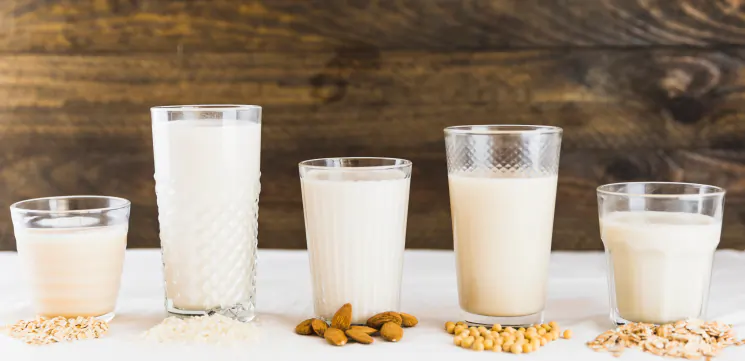
Choosing the plant base
The first step in making plant-based milk is choosing the plant base, which is fundamental in determining the final characteristics of the product. The options range from soy, almond, cashew and oats to rice and coconut, each of which makes its own unique contribution to the flavour, texture and nutritional value of the finished milk. Soy, for example, is known for its high protein content, while almond offers a delicate, slightly sweet flavour and a light texture. Cashew adds creaminess, oats bring softness and a gentle flavour, rice brings light sweetness, and coconut contributes tropical notes and a fluid consistency.
The choice of base also affects the nutritional profile of the product, including the content of macro- and micronutrients such as vitamins, minerals and antioxidants. For example, choosing almond or cashew can provide a good source of monounsaturated fats, which are important for cardiovascular health, while oat milk is rich in soluble fibre, which supports the health of the digestive system. Thus, a careful choice of plant base allows producers to satisfy consumers' diverse taste preferences, meet their nutritional needs and contribute to overall well-being.
This individualised approach to plant-based milk production helps create a product that meets the specific needs and preferences of the market, and also underlines the brand's commitment to innovation and responsibility towards consumers.
In addition, plant-based milk is often fortified with vitamins and minerals, such as calcium, vitamin D and B12, to increase its nutritional value and ensure a balanced intake of nutrients.
Production technology
Soaking and grinding
Before processing, the plant base is usually soaked to make the subsequent grinding easier. It is then ground with water to produce the plant-based "milk".
Filtration
After grinding, the mixture goes through a filtration process to separate the liquid part from the solid. The result is a smooth and uniform liquid.
Pasteurisation and stabilisation
To ensure safety and extend shelf life, plant-based milk is pasteurised. Stabilisers for plant-based milk and emulsifiers may also be added to improve texture and prevent separation.
Innovation in production
The development of modern technologies and the improvement of production processes open up unprecedented opportunities for innovation for plant-based milk producers. Today's methods make it possible not merely to reproduce the main attributes of animal milk, such as flavour and texture, but also to optimise the nutritional profile of the product, enriching it with beneficial nutrients and vitamins. Thus, through the use of advanced biotechnologies and nanotechnologies, it is possible to create plant-based milk with improved nutrient absorption and increased bioavailability of minerals and vitamins, which significantly raises its nutritional value.
In addition, flavour and texture engineering holds a central place in innovation processes, making it possible to create products that not only come close to animal milk in taste, but also offer unique variations that can satisfy the widest range of consumer demands. The use of computer modelling and flavour profile analysis helps scientists and producers determine precisely which components need to be added or changed to achieve optimal flavour and consistency, while preserving the naturalness and high nutritional value of the product.
Innovative approaches to the packaging and storage of plant-based milk also play an important role in the further development of this product category. By developing environmentally friendly, fully recyclable or biodegradable packaging, brands can reduce their environmental impact and underline their commitment to sustainable business principles.
In addition, the continuous improvement of filtration and sterilisation technologies helps extend the shelf life of plant-based milk without the use of preservatives, while preserving its natural flavour and nutritional properties. These advances ensure higher product quality and safety for consumers and improve the efficiency of logistics and distribution, opening up new markets for plant-based milk producers.
Thus, innovation in plant-based milk production continues to expand the horizons of possibility for this category, making it possible to create products that not only meet but exceed consumer expectations, while contributing to sustainable development and innovation in the food industry. The focus on environmental sustainability prompts many producers to improve their plant-based milk production methods, reducing water consumption, energy use and environmental impact.
Making plant-based milk requires a careful choice of ingredients and the use of advanced technologies in order to meet consumer demand for high-quality, tasty and environmentally sustainable products. Prodservis is proud to offer a wide range of certified food ingredients and innovative solutions for plant-based milk producers, helping them achieve exceptional product quality and meet the requirements of modern consumers.
FAQ
Which plant bases are most often used to make plant-based milk?
A variety of plant bases are used to make plant-based milk, including soy, almond, cashew, oat flakes, rice and coconut. Each of these bases gives the product a unique flavour, texture and nutritional value.
Is plant-based milk fortified with vitamins and minerals?
Yes, plant-based milk is often fortified with vitamins and minerals, such as calcium, vitamin D and B12, to increase its nutritional value and ensure a balanced intake of nutrients.
Which innovative technologies are used in plant-based milk production?
Plant-based milk production includes advanced technologies such as biotechnology, nanotechnology, computer modelling of flavour profiles, and innovative filtration and sterilisation methods, which help improve the flavour, texture and shelf life of the product.
Does innovation in plant-based milk production contribute to sustainable development?
Yes, innovation in plant-based milk production contributes to sustainable development by optimising resource consumption, using environmentally friendly packaging and applying production methods that reduce environmental impact, underlining brands' commitment to environmental responsibility and innovation.
Read also
- German technologist: what to produce tomorrow?
- Yoghurt production: from delicate texture to new product concepts with Prodservis
- European Insight: Tastes, Trends and New Products
- Marbled Beef Reimagined: Technology for Creating a Higher-Value Product
- Fertilisers for houseplants: how to choose and use them
