Potassium nitrate: correct use and properties
· Valerii Korolko · 9 min read
What potassium nitrate is
What is potassium nitrate, really? It is a white or slightly grey fertiliser in the form of crystals that gives plants two important elements at once – nitrogen and potassium. Scientifically it is potassium nitrate, but the main thing for us to know is that it genuinely works.
Potassium nitrate application has found its place everywhere – from small vegetable plots to large farms. If you want your tomatoes not to crack and your cucumbers to grow like crazy, this is your option.
The best thing is that potassium nitrate does not spoil the soil or make it acidic. It also dissolves quickly in water – pour it in, stir, and a couple of minutes later you can start watering.
Composition and physical properties of the fertiliser
Potassium nitrate is a fertiliser containing roughly 13-14% nitrogen and as much as 46% potassium. Sounds complicated? In fact it is simple: nitrogen means greenery and growth, while potassium means tasty, sweet fruit that keeps well.
Potassium saltpetre dissolves excellently – it can be mixed even in cold water, although it is quicker in warm.
And you know what I like most? It contains no chlorine! And chlorine is a disaster for tomatoes and potatoes. Many other fertilisers have it, but this one is clean. That is why I quickly understood what saltpetre is needed for: so as not to harm the plants and at the same time feed them well.
It also stores quite well. The main thing is that it should not stand in a damp room, otherwise it will cake into a single rock.
What saltpetre is needed for in agronomy
People often ask: what is saltpetre needed for if there are plenty of other fertilisers? The answer is simple – it delivers results quickly and without surprises.
Ensuring balanced plant nutrition
The effect of potassium saltpetre on plants is a complex one. Imagine: nitrogen accelerates growth, the leaves turn green, and the plant comes to life before your eyes. Potassium works as internal transport – it carries all the nutrients where they are needed and retains water in the plant so that it does not wilt in the heat.
Increasing yield and fruit quality
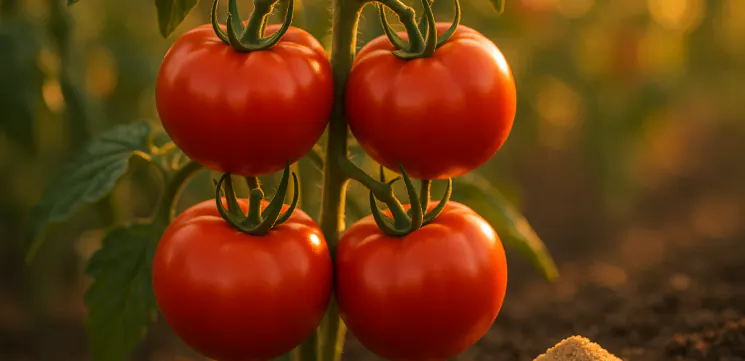
When my clients began to use potassium nitrate regularly, the tomato harvest increased by roughly a quarter. And quality is a separate subject altogether. The tomatoes became firmer and not watery. The peppers were sweeter. Even potatoes kept better in winter and rotted less.
Strengthening crop immunity and stress resistance
Here the effect of potassium saltpetre on plants does not show immediately, but it is there. Plants that receive enough potassium become stronger. They tolerate both heat and cold more easily.
Correct application of potassium nitrate
Good, we have dealt with the theory. Now to practice – potassium nitrate application requires a sensible approach, not a careless one.
Optimal application timing depending on the crop
Tomatoes, peppers and aubergines – I feed them when the first fruit sets appear. Then repeat every two weeks while they are bearing fruit. Cucumbers eat like there is no tomorrow – they can be given it more often.
Potatoes are fed when they begin to flower. That is exactly when they build up tubers. Strawberries – in spring, as soon as the leaves have emerged, and then after the berries have been harvested, so that they fruit well the following year.
Fruit trees in the orchard like potassium nitrate in May-June. Apple trees especially – the apples then fill out juicy, not dry.
Application methods – root and foliar feeding
Usually about 15-20 g is dissolved per bucket of water and applied at the root. It is only important to pay attention to each manufacturer's individual dosage and to water the plants with plain water first, and only then with the fertiliser. Otherwise you can scorch the roots if the soil is dry.
Foliar feeding – we spray onto the leaves. In that case we make the solution weaker, about 10-15 g per bucket. And spray either early in the morning or in the evening, so that the sun does not scorch the leaves.
In a greenhouse it is convenient to add saltpetre to the irrigation water tank – mix it once and water with feeding for a week. Just do not overdo the concentration.
Dosage for vegetable, fruit and ornamental plants
Vegetables in commercial cultivation:
- Tomatoes, peppers in open ground – 150-200 kg per hectare per season, applied in 3-4 doses via drip irrigation
- In greenhouses the working solution concentration is 0.1-0.15%, with constant feeding through the irrigation water
- Cucumbers – 200-250 kg/ha per season, especially during active fruiting
- Cabbage – 100-150 kg/ha in two doses: 2-3 weeks after transplanting the seedlings and at the start of head formation
- Potatoes – 80-120 kg/ha, applied during budding and at the start of flowering
Fruit plantings:
- Apple orchards – 200-300 kg/ha per season, split into 2-3 applications in May-July
- Vineyards – 150-200 kg/ha, applied three times: before flowering, after berry set and at the start of ripening
- Berry plantations (strawberries, raspberries) – 100-150 kg/ha, in spring and after fruiting
Commercial crops: On large farms potassium nitrate is often applied through fertigation systems – this is when the fertiliser is delivered together with irrigation water through drip lines. There automation controls everything and keeps the concentration constant. This brings savings – less fertiliser is used and the result is better, because the plants receive nutrition evenly rather than in one large dose.
The main thing on a large scale is not to forget about soil analyses. On large areas the soil can vary greatly, and what suits one plot may be too much or too little on another. That is why serious farmers check the soil first and only then calculate the rates.
Advantages of potassium nitrate over other fertilisers
Why do I recommend potassium nitrate in particular? Potassium nitrate is a fertiliser that does not let you down.
Firstly, there is no chlorine. I have already said it, but I will repeat it – this is very important. Tomatoes become tasteless from chlorine, and potatoes store poorly.
Secondly, the nitrogen in it is in a form that is absorbed quickly. Even if it is cold, plants will still receive nutrition. With other fertilisers you have to wait until the microbes in the soil process them, but here it is ready at once.
Thirdly, it does not spoil the soil. Many fertilisers make the soil acidic, and then liming is needed. But potassium nitrate is neutral, so you do not need to worry.
And most importantly – one fertiliser instead of two. There is no need to buy nitrogen and potassium fertilisers separately, or to think about how much of each to mix. You spread the nitrate – and that is it.
Common mistakes in use
When potassium nitrate (KNO3) is used on a large scale (industrially) as a fertiliser or as a component of other processes, it is important to avoid typical mistakes that can reduce efficiency or cause problems. Here are the most common of them:
*Inaccurate dosage and uneven application
Problem: Applying too much or, conversely, too little nitrate, as well as distributing it unevenly across the area.
Why this is a mistake:
Excess: It can lead to excessive growth of vegetative mass at the expense of fruiting (especially the nitrogen component), or even to plant burns (salt stress) due to the high concentration of salts. It is also economically disadvantageous.
Deficiency: Plants will not receive the necessary elements (potassium and nitrogen) for full development, which will reduce yield and product quality.
Unevenness: Part of the field/plot will suffer from deficiency, and another part from excess.
How to avoid it: Always carry out a preliminary soil analysis and calculate the application rate according to the needs of the specific crop and its stage of development. Use calibrated equipment for accurate and even distribution.
*Ignoring soil type and climate
Problem: Applying standard nutrition schemes without taking into account the characteristics of the site (acidic, alkaline, light, heavy soils) and weather conditions.
Why this is a mistake:
Light (sandy) soils: Potassium and nitrate nitrogen can be quickly washed out by rain or irrigation water (filtration), becoming unavailable to plants.
Weather: In hot, dry weather it may be necessary to reduce the concentration of the solution for foliar feeding in order to avoid burns.
Soil pH: The uptake of nutrients depends on soil acidity.
How to avoid it: Adapt the rates and method of application. For example, on light soils use split application (smaller doses more often) to reduce losses.
*Incorrect mixing (incompatibility)
Problem: Mixing potassium nitrate with fertilisers or plant protection products that are chemically incompatible with it, especially when preparing stock solutions for drip irrigation systems (fertigation) or for foliar treatments.
Why this is a mistake: Potassium nitrate can react with some phosphate fertilisers or fertilisers containing a high concentration of sulphates or calcium (for example, calcium nitrate), forming an insoluble precipitate.
Consequences:
The precipitate clogs the nozzles and drippers of the irrigation system, which leads to its failure and uneven feeding of the plants. There are fewer nutrients, or they become unavailable to the plants.
How to avoid it: Always check the compatibility instructions before mixing. Mix only those fertilisers that are guaranteed to be compatible, or use them separately. If in doubt, carry out a test mix of a small quantity.
*Neglecting storage rules
Problem: Storing potassium nitrate in unsuitable conditions, especially in rooms with high humidity.
Why this is a mistake: Potassium nitrate is hygroscopic (it readily absorbs moisture from the air). As a result, it can cake into large, hard lumps, which makes its even application or dissolution for liquid systems considerably more difficult.
How to avoid it: Store the product in a dry, cool room, in tightly closed factory packaging or sealed containers.
Conclusions and advice for farmers
Potassium nitrate application found its place with me long ago, and I do not regret it. It is a fertiliser for those who want results without unnecessary hassle.
My advice is simple:
Weigh the dose. Going "by eye" does not work – you will either give too little or burn the plants.
Do not be lazy about preparing a fresh solution.
Alternate root and foliar feeding. Once at the root, the next time on the leaves. Plants like variety.
Remember – potassium nitrate is not a magic wand. If you do not water, do not loosen the soil and do not drive off pests, the fertiliser will not save you. But combined with proper care, it really helps.
And one more important point: stop feeding 2-3 weeks before harvest.
If you are only starting to work with potassium nitrate, do not be afraid to experiment. Start with small volumes and see how the plants react.
Potassium nitrate really is a good fertiliser. Inexpensive, effective and safe when used correctly. Try it – you will not regret it. And then you will see for yourself how tomatoes fill out and how cucumbers grow. It is such a pleasure to gather a fine harvest! And the managers of Prodservis. will always help you make the right choice of fertiliser.
Read also
- German technologist: what to produce tomorrow?
- Yoghurt production: from delicate texture to new product concepts with Prodservis
- European Insight: Tastes, Trends and New Products
- Marbled Beef Reimagined: Technology for Creating a Higher-Value Product
- Fertilisers for houseplants: how to choose and use them
