Hydrocolloids: why are they indispensable in the food industry?
· Oleksii Tovstenko · 5 min read
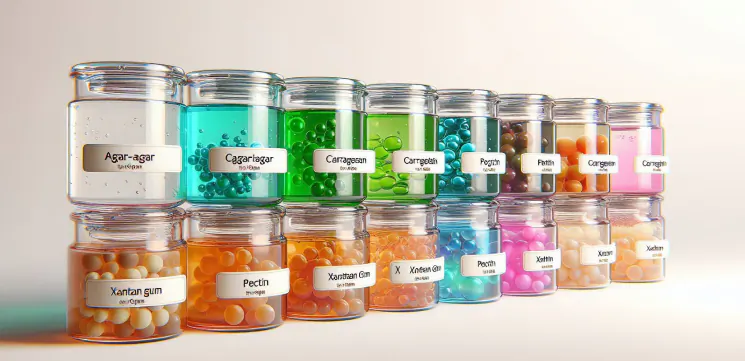
Main types of hydrocolloids
Hydrocolloids are divided into the following types:
– Source: Xanthomonas campestris bacteria.
– Stable regardless of pH and temperature; forms highly viscous solutions even at low concentrations.
– Used in sauces, salad dressings, desserts and beverages.
2. Guar gum
– Extracted from the seeds of the Cyamopsis tetragonoloba plant.
– Forms highly viscous solutions; sensitive to temperature and pH.
– Used in ice cream, puddings, baked goods and sauces.
3. Carrageenan
– Red seaweed.
– Kappa carrageenan forms firm gels, iota forms elastic ones, and lambda only thickens.
– For dairy and meat products and jellies.
4. Agar-agar
– Seaweed.
– Forms a firm, transparent gel that is resistant to high temperatures.
– Jellies, confectionery and vegetarian gelatine substitutes.
5. Pectin
– Citrus or apple peel.
– Gels in the presence of sugar and acid.
– For jams, sweets and dairy products.
6. Starch
– From maize, potatoes, tapioca and other plants.
– A paste with high viscosity when heated; unstable on freezing and thawing.
– For sauces, soups, puddings and baked goods.
7. Gelatine
– Collagen of animal origin.
– Thermoreversible gels that melt when heated and set again when cooled.
– For desserts, jellies, mousses and supplement capsules.
Applications in the food industry:
- Purpose of use
– Thickening: creating viscosity in liquid products.
– Gelling: forming structured and firm textures.
– Stabilisation: preventing separation of emulsions and suspensions.
– Moisture retention: improving structure and shelf life.
- Effect on sensory properties: they may affect taste or transparency.
- Stability
– Gelatine is heat-labile and melts when heated, whereas agar-agar is resistant to high temperatures.
– They react to changes in the acidity of the medium.
– The presence of ions affects the ability to form gels.
- They enhance or weaken each other's action and interact with proteins, affecting their stabilisation.
- Dosage and efficiency
– Efficiency depends on concentration. Low doses give delicate textures, while high doses form dense gels.
– To avoid lumps and an uneven texture, ensure even distribution.
- Method of preparation
– Sometimes special treatment is needed for complete dissolution (for example, heating or intensive mixing).
– Adding hydrocolloids at different stages of preparation can greatly affect the final result.
– Rapid hydration is needed for immediate thickening, and slow hydration for gradual texture formation.
Economic advantages of using hydrocolloid blends
- Synergistic effect
– A combination of several hydrocolloids gives a greater effect than the sum of their individual actions, which makes it possible to use less of each component.
- Improved texture
– They create complex textures that are difficult to achieve with a single component.
– Pectin + starch – structure for fruit fillings and jellies.
– Agar-agar + carrageenan – gelling and moisture retention.
- Stabilisation
– They prevent separation of emulsions, retain water and stabilise foam.
– Xanthan + lambda carrageenan – stabilisation for dairy drinks.
– Guar gum + starch – improved stability of frozen desserts.
- Process optimisation
– They improve technological aspects, reduce production costs and increase efficiency.
– Xanthan + starch – shorter production time and improved texture.
– Pectin + lambda carrageenan – rapid gel formation at low temperatures.
- Control of sensory characteristics
– They help control taste, texture, transparency and mouthfeel.
– Xanthan and guar gum – smooth, creamy textures without significantly affecting taste.
– Carrageenan and agar-agar – producing transparent, firm gels.
- Adaptation to storage and use conditions
– Resistance to changes in temperature, pH and the presence of ions.
– Agar-agar + pectin – stability under temperature fluctuations.
– Xanthan and carrageenan – resistance to a wide range of pH.
- Cost-effectiveness
– Achieving the desired properties while adding a smaller amount of each component reduces raw material costs and increases profitability.
Combining hydrocolloids opens up broad opportunities for optimising production processes. The right use of blends makes it possible to achieve complex textures, improve stability and cost-effectiveness, and produce unique products that meet consumers' needs and expectations.
Trends and innovations in hydrocolloids:
+ New sources and sustainable practices
– There is growing interest in finding new sources among sustainable and underused resources.
+ Advanced mixing technologies
– Innovations in mixing technologies make it possible to create more precise and more functional hydrocolloid blends.
+ Part of functional foods
– Hydrocolloids play an important role in developing low-calorie, fat-free or high-fibre products.
+ New developments in hydrocolloid formulations
– Improved sensory properties, which is important for creating high-quality food experiences for consumers.
+ Regulatory and consumer preferences
– Growing demand for natural and environmentally friendly ingredients is stimulating the use of hydrocolloids from natural sources.
The choice of hydrocolloid depends on many factors, including its properties, processing and storage conditions, and the end goal. The technologists of Prodservis, with many years of production experience, will help you select the optimal option for your specific production. And our wide range of stabiliser and emulsifier blends will meet the needs of both dairy producers and meat product manufacturers.
FAQ
What is a hydrocolloid?
A hydrocolloid is a substance that forms a colloidal solution, that is, a gel or a viscous liquid, when it interacts with water.
Where are hydrocolloids used?
Hydrocolloids are widely used in various industries, including medicine, the food industry and cosmetics. For example, in medicine, hydrocolloid dressings are used to treat wounds because they maintain a moist environment that promotes healing. In the food industry, hydrocolloids are often used as thickeners, stabilisers and gelling agents, such as agar-agar, carrageenan and pectin.
Which substances are called hydrocolloids?
1. **Agar-agar**
2. **Carrageenan**
3. **Pectin**
4. **Gelatine**
5. **Xanthan gum**
6. **Guar gum**
7. **Alginate**
Each of these hydrocolloids has unique physicochemical properties, which makes it possible to use them in a wide range of applications.
Read also
- German technologist: what to produce tomorrow?
- Yoghurt production: from delicate texture to new product concepts with Prodservis
- European Insight: Tastes, Trends and New Products
- Marbled Beef Reimagined: Technology for Creating a Higher-Value Product
- Fertilisers for houseplants: how to choose and use them
