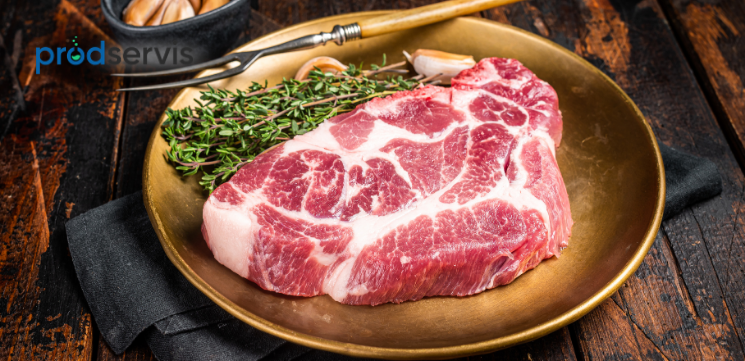

Marbled beef holds a special place in the meat market. Its fine streaks of fat are associated with steaks, premium restaurants, exceptional juiciness and a corresponding price point.
Natural marbling develops during the animal’s lifetime. Genetics, breed, feeding, age and farming conditions all influence the result. For meat processors, this creates dependence on both raw material quality and cost.
Modern food technology offers another approach. Marbling can be created during processing by injecting a specially prepared emulsion into the muscle tissue. After stabilization, a characteristic marbled pattern appears inside the cut. As a result, familiar beef gains new product potential.
Can a more affordable lean cut of beef become a higher-value product? Let’s find out.
What Is Technologically Marbled Meat?
Technologically marbled meat is produced by creating the fat pattern during processing rather than during the animal’s lifetime. A specially prepared fat emulsion is injected into the muscle tissue.
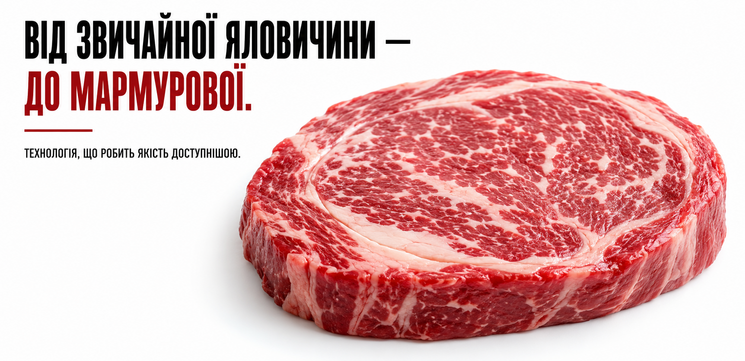
The principle is easy to understand, even without a background in food technology:
meat cut → prepared emulsion → injection → stabilization → product with a characteristic marbled appearance
Natural marbling and technologically created marbling have different origins. Therefore, this product should be considered a separate technological solution. It is not a way to turn ordinary beef into Wagyu.
PRALLO® Marbled Beef Opti: A Technology You Want to Put to Work in Your Own Production
Prodservis offers PRALLO® Marbled Beef Opti from the German manufacturer VAN HEES. This functional ingredient opens a new way to work with a familiar cut of beef.
Slice into the finished steak. A browned crust covers the outside, while the meat inside remains juicy and shows a pronounced marbled pattern. This is the kind of result that makes you want to move beyond the catalogue. You want to put the technology on the injector and test it with your own raw material.
PRALLO® Marbled Beef Opti is used to prepare a stable emulsion based on cold water and vegetable oil. The emulsion is injected directly into whole-muscle beef. After injection and stabilization, the characteristic marbled structure forms inside the cut.
How Is the Marbled Structure Created?
The basic technological process uses an emulsion consisting of:
- 56% cold water;
- 35% vegetable oil;
- 9% PRALLO® Marbled Beef Opti.
The working temperature of the emulsion is 2–5°C. The recommended injection level is 35–40% in two passes. Once prepared, the emulsion should be used within 4–6 hours. After injection, the meat should stabilize for approximately 24 hours.
In addition, the official PRALLO® Marbled Beef Opti specification provides a dosage reference of 85 g/L at a 40% injection level.
These parameters provide a starting point. However, actual production results will depend on several factors. These include the cut, muscle structure, injector, temperature and actual injection level. The subsequent cooking method will also affect the final result.
Why This Technology Matters for Ukrainian Producers
First, look at beef through the eyes of the consumer. A good steak should be juicy. The cut should look attractive, with visible marbling and a browned crust after cooking.
For the producer, the picture comes with a practical calculation: how much does the raw material cost, and how much can be earned from the finished product?
Ukraine’s beef market has contracted significantly in recent years. According to the State Statistics Service of Ukraine, domestic food consumption of beef and veal fell from approximately 347 thousand tonnes in 2015 to 204 thousand tonnes in 2024. That represents a decline of around 41% in nine years.
Simply putting another piece of beef on the market is becoming increasingly difficult. Consumers need a clear reason to choose one product over another.
Technological marbling can address both sides of this equation. Consumers get a juicy steak with an attractive marbled appearance. Meanwhile, producers can develop a higher-value product with more predictable costs. They do not have to rely exclusively on expensive naturally marbled raw material.
The opportunity also extends beyond a single product. Possible formats include steaks for home grilling, a BBQ range and restaurant-ready preparations. Thinly sliced beef for hot pot and other Asian cooking formats can expand the range further.
One cut. One technological idea. Several directions for new SKUs.
The Economics of Marbling: Calculating the Result per 100 kg of Beef
A marbled appearance attracts attention. Juiciness adds consumer value. From a production perspective, another number matters: how much finished product can be obtained from every 100 kg of meat raw material?
Take the same starting point in both scenarios: 100 kg of beef.
Without the system, 79 kg of finished product remains after cooking. In other words, the weight loss is 21%.
With the technology, 40% emulsion is added to 100 kg of beef. After cooking, the stated result is 132 kg of finished product.
100 kg of beef → 79 kg after cooking
100 kg of beef + 40% emulsion → 132 kg after cooking
Based on the same initial 100 kg of meat raw material, the comparison is −21% versus +32% of the initial meat weight.
What Does the Producer Gain Beyond the Marbled Appearance?
An attractive cut is the first thing the consumer notices. Yet the production value goes much further. The technology allows processors to work with yield, sensory characteristics, product range and future positioning.
- A familiar production process. Emulsion preparation and injection are already familiar operations for meat-processing companies. With suitable equipment, the new concept can be developed without creating a separate production line.
- Controllable marbling. By adjusting the injection level, selecting the cut and fine-tuning process parameters, technologists can adapt the product to a specific goal. This may be a steak, thin slicing, BBQ or a HoReCa format.
- A flavour profile that can be developed. Flavouring the emulsion creates room for different concepts based on the same technological platform. Options can range from a classic version to BBQ or a special restaurant recipe.
- Juiciness and tenderness of the finished meat. Distributed throughout the muscle tissue, the fat phase melts during heating. A browned crust forms on the outside. Meanwhile, the meat retains its texture and remains juicy.
- A product made for the grill. Marbling already creates visual appeal on the shelf. After cooking, a browned crust and juicy centre add another layer of consumer appeal. These characteristics need little explanation.
- Potential for frozen formats. The technology can also be developed for frozen products, HoReCa and longer logistics chains.
- The ability to work with the fat profile. Vegetable oil is part of the emulsion. Therefore, producers can select the type of oil according to the product objective. The final formulation will determine the specific fatty acid composition.
- One technological principle, several SKUs. Steak may be only the beginning. The same technological base can support different formats for retail, HoReCa and private label.
Beyond Steak: Where Else Can Marbled Beef Work?
A classic steak is the most obvious option. However, marbled appearance, portioning and quick preparation allow the concept to go much further.
- Steaks and BBQ. Possible products include portioned steaks for home grilling and BBQ sets. The same concept can also be used for plancha cooking and professional restaurant preparations.
- Thinly sliced beef. A pronounced marbled pattern creates visual value even before cooking. This format can work for quick cooking and portioned restaurant serving.
- Asian formats. Korean BBQ, teppanyaki, hot pot, sukiyaki and shabu-shabu use thin slices of meat that cook within minutes. In these formats, the appearance of the raw product has particular importance.
- Raclette, plancha, hot stone and fondue. Here, meat becomes part of the gastronomic experience. Guests see the product before cooking, watch the process and experience the final result.
- Retail and ready-to-cook. Portioned steaks, grill sets, chilled products and frozen formats can form a separate supermarket range.
- HoReCa and private label. Restaurants, hotels, grill concepts, Asian restaurants and retail chains can receive a product adapted to their needs. Format, portion weight, flavour profile and cooking method can all be tailored.
100 kg of beef can remain simply raw material. Or it can become the basis for several products, different sales channels and new category economics.
From a Technology Trial to a Commercial Product
PRALLO® Marbled Beef Opti should be considered as more than a functional ingredient. For producers, the real value lies in the finished product it can help create. The selling price and resulting margin matter as well.
That is why a trial should start with a specific business objective. It may be a retail steak, a BBQ range or a restaurant-ready product. Another option is thinly sliced beef for an Asian format or a private-label product.
Next come the raw material, formulation, injection and stabilization. Then comes the first cut and cooking test. After that, the numbers behind the launch decision can be calculated: actual yield, cooking losses, cost, selling price and margin.
Want to find out what PRALLO® Marbled Beef Opti could deliver in your production?
Contact the Prodservis technologists. We will test the technology using your raw material and equipment. Then we will evaluate the finished product and calculate its economic potential.
PRALLO® Marbled Beef Opti at a Glance
- Manufacturer: VAN HEES, Germany.
- Purpose: emulsifier for the production of meat preparations.
- Basic emulsion: 56% cold water, 35% vegetable oil, 9% PRALLO® Marbled Beef Opti.
- Recommended injection level: 35–40% in two passes.
- Working emulsion temperature: 2–5°C.
- Dosage reference from the specification: 85 g/L at 40% injection.
- Allergen: milk and products thereof.