Sodium acid pyrophosphate Prayphos SAPP FG (E450)
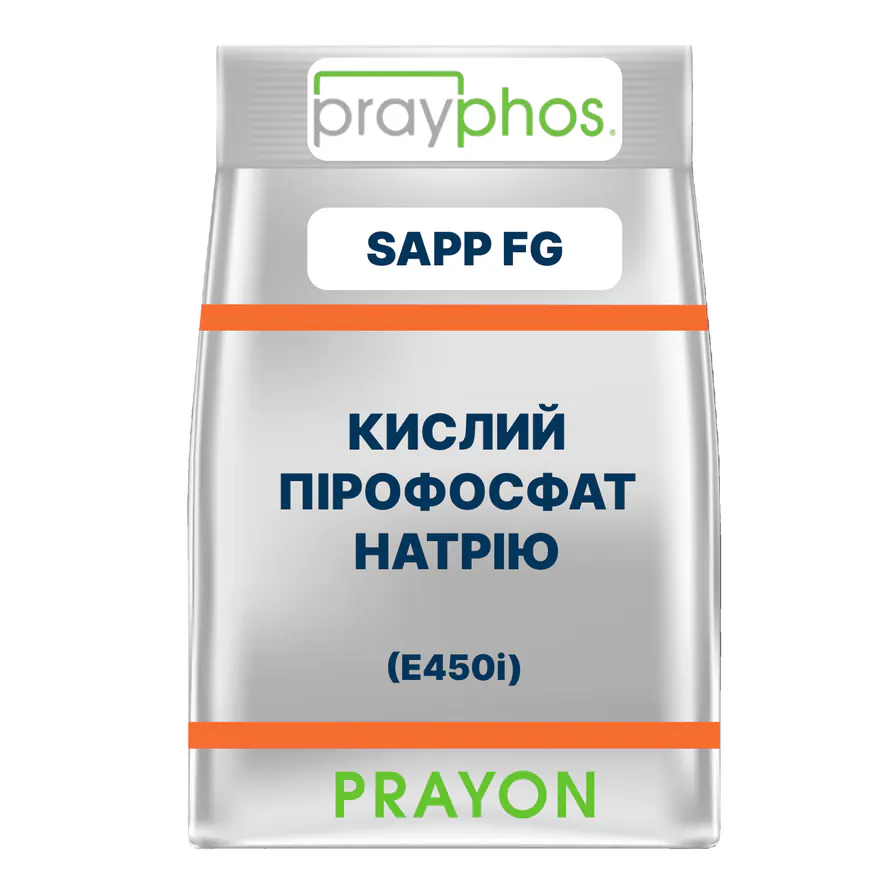
- Manufacturer
- PRAYON
- Country
- Belgium
- Availability
- On request
- Packaging
- 25 kg
Composition
Food-grade sodium acid pyrophosphate E450i
Dosage
0.2–0.4 kg/100 kg
Description
SAPP FG (E450i) is a food-grade acid sodium pyrophosphate of the Prayphos brand from the Belgian manufacturer PRAYON, pH 3.8-4.5. It is a white water-soluble powder used mainly in the bakery industry as a raising agent and acidity regulator.
SAPP FG acts quickly, so the dough rises fast, which is decisive for achieving the required texture in certain types of baked goods. For example, in delicate cakes or fluffy pancakes it ensures a fast and effective rise and the desired lightness.
How SAPP FG works in dough
When the dough is mixed and moisture is added, SAPP reacts with baking soda (sodium bicarbonate) and produces carbon dioxide. In fact, 22-40% of the gas is released already during the initial two-minute mixing. The rest of the gas, over 50%, is released on heating during baking.
Raising agents give baked goods airiness and volume, and also affect the characteristics of the dough. In addition to interacting with soda, these acids form ionic bonds with the starch and proteins of the dough.
SAPP dissolves easily and forms the pyrophosphate anion, which interacts with proteins and creates a moist texture. It also provides a dough buffer system in the pH range of 7.3-7.5, which affects the colour of baked goods. The lower the pH, the whiter the crumb and the less the crust browns. At a higher pH, on the other hand, the crumb has a yellowish or cream shade, and the crust may be dark brown.
Acidity regulation
The food additive SAPP is an acid salt. In water it dissociates into phosphate anions and hydrogen ions (H+), and during hydrolysis it also forms dihydrogen phosphate ions (H2PO4-). It is the hydrogen ions that make the solution acidic and lower its pH.
The role of SAPP in acidity regulation covers the following areas:
- Increasing acidity: in food products or pharmaceutical preparations, the additive releases hydrogen ions, so acidity rises and pH falls.
- Regulating pH balance: SAPP neutralises alkaline components, such as sodium bicarbonate in food products. As a result, the acid-base balance of a food or pharmaceutical product is adjusted to the requirements of a specific application.
Thus, SAPP regulates acidity by releasing hydrogen ions and maintains the pH and acid-base balance required in food production.
Applications of SAPP FG in food products
- Cakes and muffins: a light, fluffy texture requires careful pH control. SAPP FG maintains the required acidity, so the dough rises evenly, without a dense or overly compact structure.
- Bread: the structure and softness of the crumb, especially in yeast-free bread, depend on the controlled release of gas from raising agents. Here SAPP works in tandem with baking soda: it produces carbon dioxide and ensures the correct dough pH for a good rise.
- Biscuits: the crispness and consistency of biscuits depend on the level of acidity. The additive maintains a constant dough pH, so baking gives a consistent result every time.
- Processed potatoes: SAPP is often used in frozen French fries and other potato products. It preserves colour and prevents unwanted darkening during storage and cooking.
- Chilled dough: from pizza bases to certain types of baked goods, such dough rises correctly during baking, because SAPP regulates its acidity.
- Canned seafood: the shelf life and texture of canned shrimp and crab depend on acidity. SAPP therefore helps to control it, preserving the texture and freshness of the seafood.
- Cheese: in some types of cheese, SAPP regulates acidity and thus affects texture.
A Prodservis technologist will help you select SAPP FG or another raising agent acid for your dough type and baking regime and will provide the specification.
A technologist will send prices, availability and documents: +38 050 425 50 04, dd@prodservis.com.
